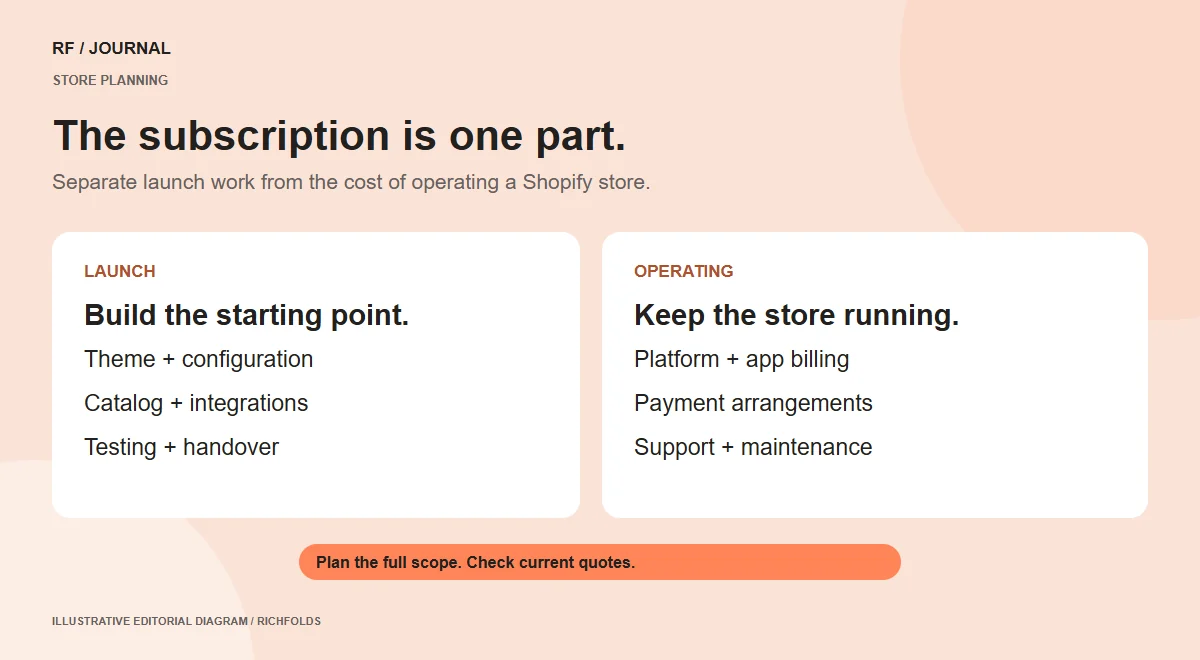
Planning Shopify store costs means considering both the launch and the work required to operate the store. The platform subscription is one part of that budget. Catalog preparation, theme work, applications, integrations, payment arrangements and ongoing support can change the total substantially.
There is no honest universal project price for every store. Build a budget from the actual requirements and current quotations. This guide is a planning framework, not a price list or financial recommendation.
Separate launch costs from recurring costs
Create two worksheets. The launch sheet covers work needed to reach an agreed release: design, configuration, product import, integration setup and testing. The recurring sheet covers the platform, applications, usage charges, support and recurring operational tasks.
Describe the deliverable beside each line. A theme purchase and a customized theme implementation are different items. A product import can mean transferring clean data or repairing inconsistent attributes before migration. The labels should reveal that difference.
Account for the catalog and connected systems
The number of products is only one indicator of complexity. Variants, subscription behavior, markets, inventory sources and fulfillment arrangements can matter more. List the systems that need to exchange information and specify which data moves in each direction.
For an example store, a warehouse connection may require mapping identifiers, handling failed updates and testing order status changes. Budget for that work explicitly rather than treating the integration as complete when credentials have been entered.
Review app and payment arrangements
Use current platform and application documentation to confirm pricing and billing details. Shopify-billed applications can involve recurring or usage-based charges, and some services have a separate billing relationship. Record the relevant cycle and owner for each cost.
Payment-related costs depend on the actual provider, plan and arrangement. Verify the terms for the proposed store instead of copying a fee from an old comparison article. Do not describe an advertised trial or promotion as the permanent operating price.
Define what maintenance covers
A support agreement should explain the work included, how changes are requested and how urgent incidents are handled. Identify who maintains app configuration, catalog accuracy and custom integrations. Specify whether new features are part of routine support or separately scoped work.
Ask the provider to explain assumptions about traffic, order volume and editing frequency. An estimate becomes more useful when the business can see what would cause it to change.
Compare options on the same basis
Use a shared requirement list when comparing proposals. Include ownership of accounts, theme assets and data, as well as training and handover. A smaller launch quote may omit testing or operational work that another proposal includes.
Before approval, check that each important line has an owner, a current source and a clear purpose. The CMS selection guide provides a broader framework for matching platform choices to the way a team works.
A budget worksheet with explicit assumptions
Use five fields for every line: deliverable, billing basis, quantity, source date and owner. For a recurring app, record the billing currency and cycle as well. Convert annual charges into an annual comparison, but keep the actual invoice dates visible so the team can plan cash flow.
Here is a fictional arithmetic example, not a Shopify quotation or a market-price benchmark. Suppose a store has $2,000 of one-time implementation work, a $30 monthly tool and a $120 annual service. Twelve months of the recurring items total $480: $30 × 12 + $120. Adding the one-time work gives a first-year planning subtotal of $2,480. The same listed recurring items would be $480 in a later year only if their prices and scope remained unchanged.
That subtotal deliberately excludes the platform subscription, payment and transaction charges, taxes, shipping labels, currency conversion, usage overages and staff time. Those are unresolved lines, not free services. Replace every fictional amount with a current quotation before making a purchasing decision. Do not combine a temporary discount with a full-price comparison without showing when the discount ends.
- Catalog preparation: define the number of items to clean, required attributes and responsibility for missing data. Use the catalog and filters checklist to make the deliverable specific.
- Applications: list what each app does, its billing basis and dependencies. Run an app dependency audit before assuming an existing subscription can be removed.
- Order operations: scope the delivery promise and returns and exchanges workflow alongside the storefront. Include who handles exceptions.
- Wholesale requirements: if relevant, document the buyer, catalog and payment rules before accepting a general retail estimate.
Ask each supplier to mark included, excluded or pending beside the same requirement list. If one proposal includes import cleanup and another assumes clean data, request comparable scopes before comparing totals. Keep a separate risk allowance with a reason and an owner; do not hide unknown requirements inside an unexplained percentage.
Updated 19 October 2026: added a practical example and implementation checks. Examples are illustrative unless a specific studio measurement is identified.