
A return request is not a refund, a shipping label is not proof that an item arrived, and a replacement suggestion is not a confirmed exchange. These differences sound obvious until a customer-facing message collapses them into one cheerful “All done.”
Plan Shopify returns as a sequence of owned steps: request, review, return instructions, receipt and resolution. Give the customer an accurate next action at each stage, and give staff a queue they can manage independently of a notification email. Configure the tools around the business's approved policy rather than letting the interface invent the policy.
This guide uses a fictional apparel and footwear store. It is an implementation framework, not a client case study, legal policy template or promise of reduced return rates. Official Shopify documentation was checked on 19 October 2026; confirm the intended account, region and connected apps before implementation.
Map the current process before selecting a returns app
Ask support, warehouse and store-management staff to describe the same return from their own perspective. Who receives the request? Who approves it? Who checks the item when it arrives? Who confirms the final outcome to the customer?
Write down the actual steps and the places where information lives. The support inbox, order record and warehouse note may describe different stages. A new portal will not automatically reconcile them.
Identify the problem you intend to solve. It might be repeated customer emails, missing return reasons, unclear status or manual entry between systems. Choose the first improvement around that problem instead of starting with an app's longest feature list.
For the fictional store, the initial scope is straightforward: customers can submit an eligible return request, staff review it and the resulting item is tracked through resolution. Unusual commercial exceptions remain with the responsible staff member during the pilot.
Understand what Shopify self-serve requests do
Shopify's self-serve documentation describes customers submitting requests through their order status page, with staff reviewing them in the admin. The business can approve or decline under its policies and provide the relevant next steps.
The distinction between return and exchange matters. The setup guidance states that customers cannot request exchanges directly through self-serve returns. Staff can add exchange items when reviewing an approved return. Do not build public instructions that promise a self-service replacement selector unless your actual configured solution provides it.
The setup also depends on access to the supported customer-account experience. Review the current requirements rather than assuming the store's existing account button is sufficient. Verify the actual route a signed-out customer follows.
Treat these as current capabilities, not a new release announcement. The practical work is deciding how they fit your process, then testing that configuration with controlled accounts and orders.
Translate the approved policy into understandable conditions
Have the responsible business owner approve the return rules before configuring them. Record the relevant item conditions, request window, shipping arrangements and exceptions. This article does not determine what policy the store should adopt.
Make sure the public explanation agrees with the configured rules. If the policy says one thing and the portal permits another, staff will be left resolving a disagreement the website created. Review both together.
Use realistic product scenarios. A single footwear item, several apparel variants and an order containing an excluded item can behave differently. Do not assume one successful request establishes that every combination is configured correctly.
Keep an escalation route for unusual cases. A rule should not silently turn a complicated customer issue into an unexplained rejection. Staff need enough information and authority to resolve the case through the agreed process.
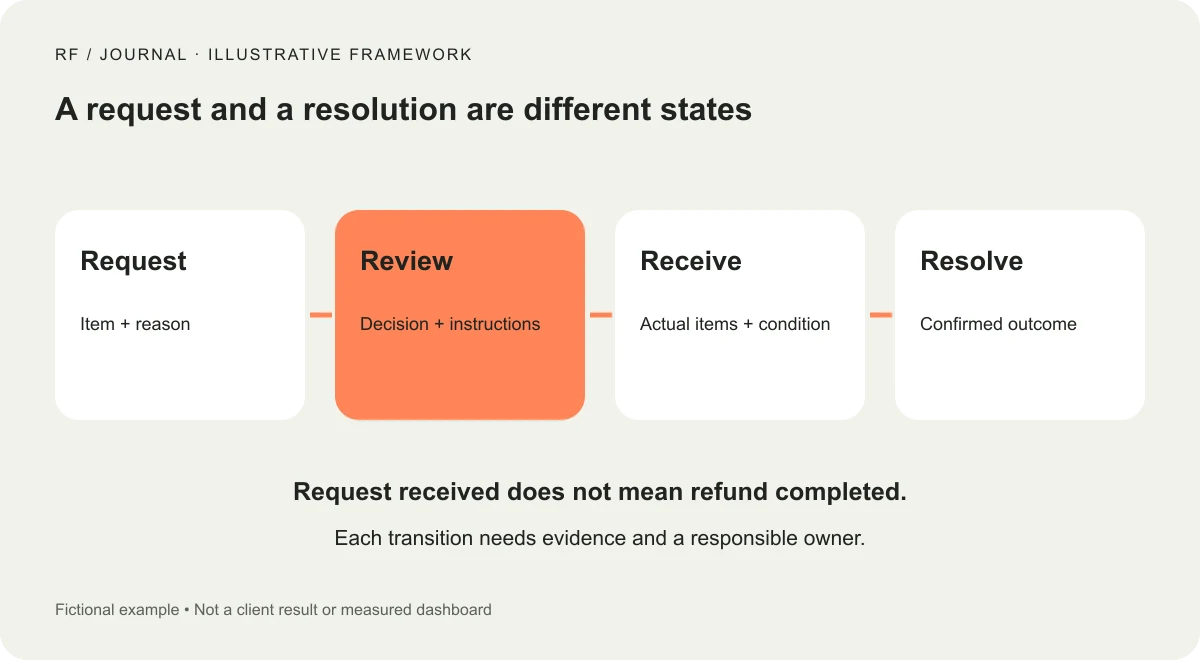
Conceptual operating workflow. Product images and interface examples are fictional.
Make the entry point easy to identify
Use clear links from the places customers expect, such as the returns information page and account area. The label should describe the task. A vague help link makes customers search for a process they are already trying to follow.
Test the signed-out route with a controlled account. Can the customer identify their order, select the intended item and understand the information requested? Review the narrow-screen experience as well as desktop.
Do not require customers to decipher internal product identifiers. Show useful variant details and quantities so they can identify the item. A return for the wrong size should not become a second support conversation because the interface only displayed a generic product name.
Where a customer cannot complete the route, show a useful contact option. It should explain what information the team needs without asking for unnecessary sensitive details. Keep the fallback connected to the same order process.
Use statuses that describe what has actually happened
A customer should be able to distinguish request received from return approved. They should also understand whether they need to ship the item, wait for instructions or provide missing information. Use the platform's actual states and the business's supported communication process.
Avoid saying a refund is complete before the corresponding action has occurred. Similarly, do not treat a label being created as evidence that the parcel was handed to a carrier or received by the warehouse.
Check the wording of notification templates alongside the account page. The two should not tell different stories. A message can be brief while still identifying the order, relevant item, current status and next action.
Keep expectations realistic. If staff review is required, say so. If a follow-up estimate depends on an operational schedule, have the responsible team confirm it before publishing a universal deadline.
Give staff a queue with a clear owner
Shopify's request-management guidance describes reviewing requests, approving or declining them, adding exchange items and providing return instructions. Use those supported actions as the basis for the operating workflow.
Assign responsibility for new requests and unresolved cases. An email notification can alert someone, but it should not be the only way the team knows which requests exist. Agree on a routine for inspecting the actual queue.
Record the decision and enough context for the next staff member. A warehouse colleague should not have to infer the approved outcome from an informal chat message. Keep internal notes distinct from customer-facing explanations.
Review permissions. Staff should have the access needed for their role without casually sharing an administrator login. The exact configuration depends on the store and tooling; document who can approve, refund and change rules.
Treat an exchange as an inventory and communication decision
For the fictional footwear store, a customer might prefer another size. Staff need to know whether the replacement is available, which item is being returned and what the intended commercial outcome is. A friendly recommendation alone does not settle those questions.
Define when the replacement is reserved or fulfilled under the chosen system. Verify that timing with operations. Do not promise a held item if the implementation has not established a reservation.
Review price differences, shipping arrangements and the communication the customer receives. Those decisions belong to the business's approved process, not to an automatic assumption that every replacement has the same value or conditions.
Test an unavailable replacement. The customer should receive an accurate alternative or explanation rather than a confirmed exchange for an item the store cannot supply. Record who makes the next decision.
Follow the returned item into the warehouse
Decide how the physical parcel is associated with the original request. The receiving team needs a reliable reference and a way to record the actual items and quantities received. A parcel arriving is only useful evidence if it can be matched to the correct case.
Define the inspection step and the possible outcomes. Avoid automatically returning an item to available inventory simply because a request exists. The team needs to assess the item under the store's agreed process.
Check partial receipt. If a customer sends one item from a multi-item request, the remaining case should not disappear into a generic completed state. The record should reflect what actually arrived.
Our delivery-estimate guide separates operational stages from the customer promise. The same principle applies in reverse: shipping, receipt, inspection and resolution are different events.
Keep connected systems consistent
If a returns app, warehouse service or accounting integration participates, map which system owns each status. Define how the order reference and item identifiers pass between them. Do not rely on matching free-text product names.
Handle repeated messages without duplicating an action. A retried notification should not create another case, another label or another financial operation. The implementation should recognize the intended operation and record its outcome.
Make failed synchronization visible. Staff need to know whether a decision is waiting to reach another system, completed or needs attention. A silent integration failure can leave the customer and warehouse working from different information.
Choose a recovery process appropriate to the operation. Avoid automatic repeated refunds or inventory changes while the result is uncertain. Authorized staff should reconcile the case using the relevant system records.
Run the awkward test cases before inviting everyone
Create a small acceptance matrix using controlled orders and the platform's supported test process. Confirm the expected result before running each scenario. Record both the customer-facing status and the internal record.
| Scenario | What the team needs to verify |
|---|---|
| Eligible single item | Correct request, notification and review route |
| Part of a larger order | Correct quantities and remaining items |
| Item outside configured rules | Understandable explanation and support route |
| Desired exchange unavailable | No unsupported replacement promise |
| Parcel partly received | Actual receipt remains distinguishable from request |
| Duplicate event or staff action | No unintended repeated business operation |
Also test the communication after a decline or a request for clarification. Internal reasons and public wording serve different purposes. The customer should receive an understandable explanation appropriate to their case, not an unexplained internal code.
Use return reasons as questions, not automatic conclusions
Review the reasons customers provide for recurring themes. A cluster of size-related returns may justify inspecting the size information, imagery or selection controls. It does not automatically prove which element caused the problem.
Combine the feedback with the relevant product evidence and staff observations. Our product-filter guide explains how useful catalog information supports selection. Better discovery may be worth investigating when customers consistently struggle to identify the right product.
Keep measured return rates and business outcomes separate from implementation completion. A new portal being live does not establish that it reduced returns, saved staff time or improved retention. Those claims require an appropriate baseline and follow-up evidence.
Launch a small, supportable process first. When customers know the next step and staff can trace the case through resolution, the returns interface becomes useful to both sides of the counter. The goal is a clear outcome, not merely a more attractive way to ask what happened to the parcel.
Include the integration, staff ownership and exception handling in the store operating-cost plan.