An AI shopping assistant cannot reliably explain a product that the store itself describes three different ways.
If the title says cotton, the specification says a blend, and the selected variant has no clear availability, another layer of persuasive copy is unlikely to solve the underlying problem. You have given the assistant a small mystery. Your customer wanted a T-shirt.
For a Shopify merchant, a useful first move is to review the information being distributed, the channels that can receive it, and the buying journey customers actually reach. Start there before paying for a tool that promises to make the catalog irresistible to every AI on the internet.
This guide explains a practical review process: check eligibility, audit a small product sample, verify channel-specific behavior, test the handoff to checkout, and measure what you can actually observe.
Checked on 16 October 2026. This is documentation-based guidance, not a report of a RichFolds client deployment or a ranking experiment. Product examples and illustrations are fictional. Channel access and behavior can change.
Why we chose this topic after checking Google Trends
We compared the search terms “Shopify AI,” “AI shopping,” and “headless CMS” in Google Trends, using the United States, Web Search, all categories, and the past-90-days setting on 16 October 2026.
The displayed average relative-interest scores were 23 for Shopify AI, 13 for AI shopping, and 8 for headless CMS. Shopify AI had the strongest average in that particular comparison, but its recent values were below earlier peaks. We are not describing it as a new breakout or claiming that this article’s exact title has proven demand.
Google explains that Trends data is sampled and normalized. These scores are not monthly search volumes, market share, purchase intent, or a forecast of article traffic. They helped us choose an area worth examining; the merchant problem determined the article.
That distinction is useful for your own content planning. A chart can identify interest. It cannot tell you whether your next paragraph is helpful.
First separate discovery from checkout
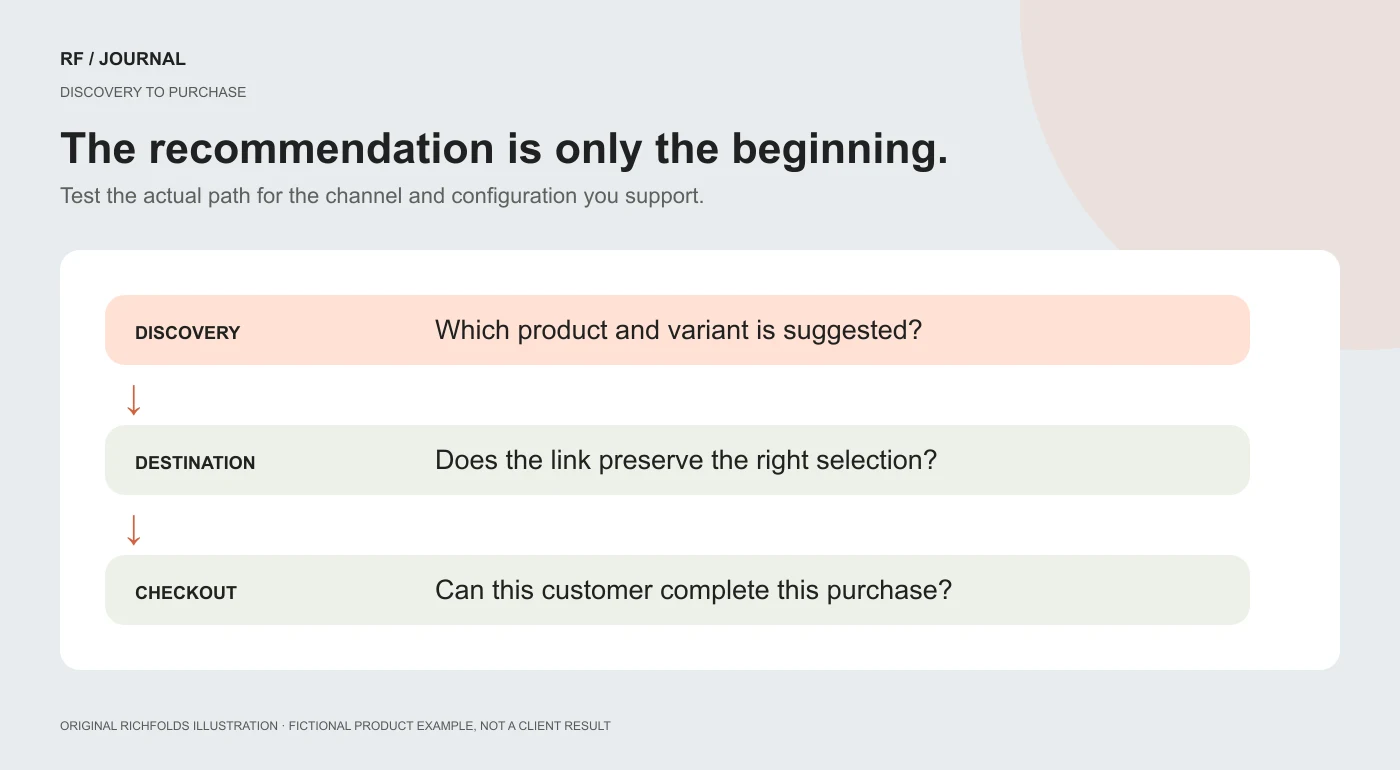
“Selling through AI” can mean more than one journey. A channel might help a shopper discover a product and send them to your store. Another supported setup might provide a checkout within the channel. Those experiences need different checks.
Shopify’s current agentic storefronts overview describes channel management under Sales channels > Agentic. It distinguishes discovery-focused referrals from direct checkout in supported channels and configurations. Eligibility and the relevant supplemental terms matter; an announcement is not confirmation that every store can use every feature.
For example, Shopify’s ChatGPT channel documentation says purchases complete in the merchant’s online-store checkout through an in-app browser or a new browser tab. Its listed requirements include selling to US customers, eligible products, completed store policies, and agreement to the applicable terms.
Do not turn those details into a universal description of all AI shopping. Write down the actual journey for each channel you intend to support. If someone says “it’s all integrated,” ask them where the customer pays, which product variant arrives, and who handles the order afterward.
Those questions are less glamorous than a launch video. They are also where a shop becomes a shop.
Check the store’s status before rewriting the catalog
Open the relevant channel settings and inspect the status shown for your store. Read any ineligibility reason before deciding what work is needed. Check the documentation linked from that account rather than relying on an old onboarding screenshot.
Then record the basics: which channels are enabled, which products are eligible, what market you sell into, and what terms or configuration decisions the merchant must review. Keep a dated note because these settings are part of the operating setup, not just a one-time design task.
Shopify’s catalog discovery guidance explains that products can be discovered through Shopify Catalog and other routes, including crawling or feeds. It also explains that Google surfaces use their relevant Google channel connection. Being absent from one distribution route does not prove that the product is invisible everywhere.
This is why the review needs a channel list rather than one large checkbox labeled “AI ready.” That checkbox looks reassuring, but it is doing several jobs without a job description.
Audit a small, representative product sample
Do not begin by rewriting thousands of descriptions. Choose a manageable sample that exposes different failure modes: a simple product, a product with several variants, an item on sale, an unavailable variant, a bundle, and a product with an important compatibility limit.
For each one, compare what a shopper sees with the product record and the information sent through the relevant channel. The aim is agreement, not the greatest possible number of keywords.
Use a review sheet with these fields:
| Information | What to check | What a useful correction looks like |
|---|---|---|
| Title | Does it identify the item without unsupported claims? | A specific product name with the relevant distinguishing detail |
| Description | Are material, intended use, and limitations consistent? | Plain facts supported by the supplier or product documentation |
| Options | Do color, size, and other labels refer to the right variants? | Consistent names linked to the actual item being bought |
| Price and currency | Does the selected item show the correct current offer? | Agreement between the page, cart, and applicable feed |
| Availability | Is the chosen variant genuinely available? | A clear state and a useful recovery path when unavailable |
| Images | Do the photographs correspond to the variant? | Accurate imagery with understandable descriptions |
| Policies | Are delivery and return details easy to find and accurate? | Current policy information presented in the right context |
| Destination | Does the supplied link open the intended product or variant? | A working URL that preserves the relevant selection |
This is a suggested audit, not a claim that every field above is mandatory in every channel. Follow the requirements for your actual product category and destination.
Give product facts an owner
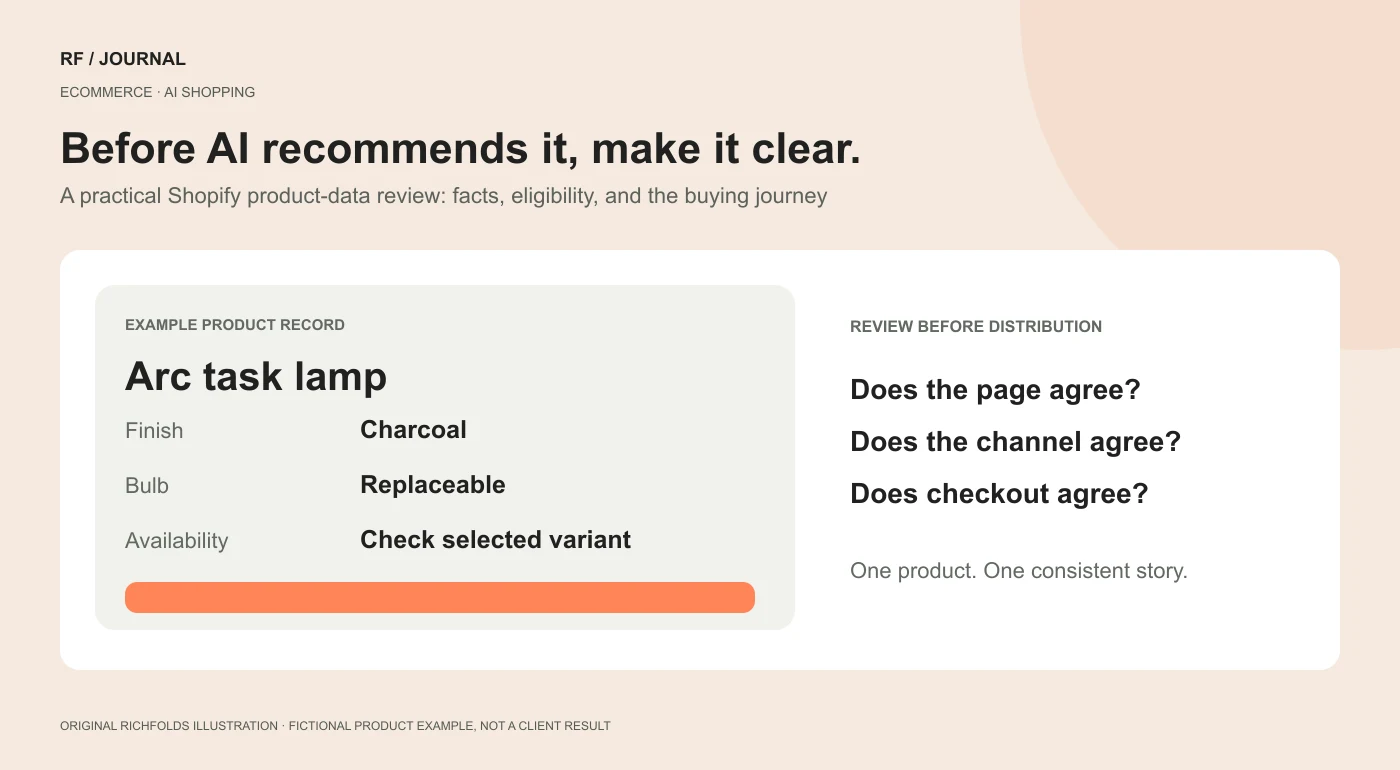
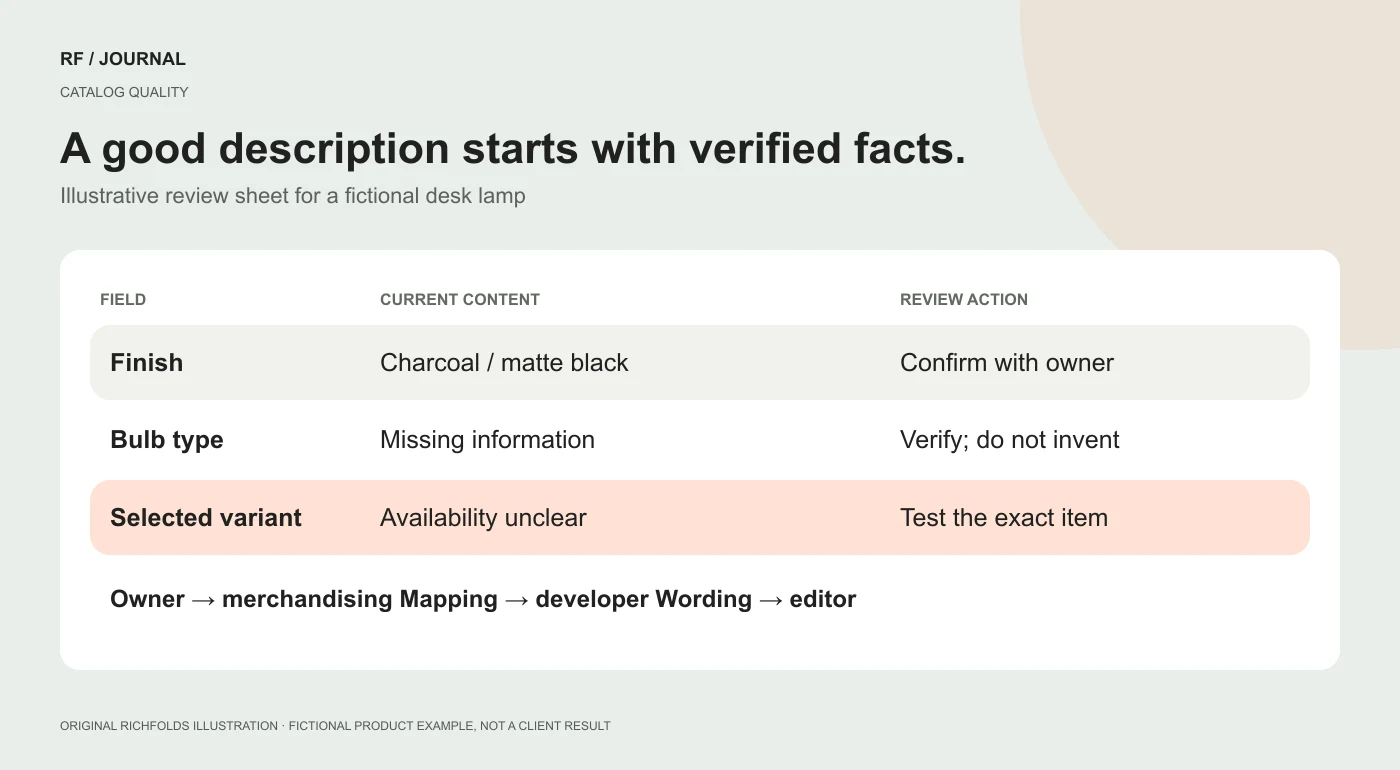
Imagine a fictional desk lamp. Its name is “Arc task lamp,” it uses a replaceable bulb, and its finish is charcoal. The merchandising team keeps the finish in a custom field, while an old description still calls it matte black. Neither wording is automatically wrong, but the team needs to decide whether the terms describe the same finish and which record is authoritative.
Assign ownership before asking an AI to resolve that ambiguity. Merchandising can confirm the finish. A developer can check how custom fields are mapped. The editor can update the public wording after the fact is settled.
Without an owner, a rewriting tool may make both descriptions sound excellent while leaving them contradictory. You get better sentences and the same problem, now with a more confident tone.
Do not invent dimensions, materials, certifications, or compatibility details to fill an empty field. Mark missing information for verification. A blank that triggers a supplier question is more useful than a plausible specification that nobody checked.
For a broader look at how catalog consistency affects the shopping experience, see our guide to Shopify product filters. The same data often needs to support several experiences, so correct the source rather than maintaining a different story for every destination.
Inspect custom mapping instead of assuming every field travels
Custom storefronts often keep useful information outside standard product fields. That might be sensible for the website, but the team should verify how those fields reach each distribution route.
Shopify documents Catalog Mapping for eligible stores that use custom data and product-grouping logic. Check the mapping available in your account, especially when important titles, descriptions, categories, or variant relationships depend on custom fields.
The practical test is a round trip. Start with a verified fact in the product record. Find how it appears on the storefront. Inspect how the relevant distribution system represents it. Record where it is missing, transformed, or attached to the wrong variant.
Do not solve a mapping problem by pasting the entire specification into the title. A title should help identify the product. It does not need to arrive carrying the whole warehouse database.
Make visible product information and structured data agree
Your page also needs to make sense to systems that read the website directly. Google’s merchant-listing documentation describes Product and Offer structured data for eligible search experiences and recommends validation with the Rich Results Test.
Structured data is a representation of product information, not a separate place to tell a more attractive story. Compare the relevant offer with the item the shopper actually sees.
Google’s Merchant Center guidance explicitly requires structured values to match the displayed information for the matching process it describes. It also addresses identifying individual offers when multiple variants appear on a page.
Ask your developer to inspect a representative set of URLs and states. Does the initial page represent the expected variant? What changes when another option is selected? Does the current sale price match the offer in the relevant structured data and feed?
A passing validation result does not guarantee a recommendation, a rich result, or a sale. It is evidence about a technical check. Keep the distinction clear when explaining progress to a client.
Test the landing and checkout journey yourself
When a channel sends a shopper to your store, the destination should continue the decision they were making. Test the supplied link in a fresh session and on a narrow screen, not only in the browser where you have been editing the product all morning.
Confirm the product, selected options, price, availability, and currency. Add the intended variant to the cart. Check whether an unavailable option is handled clearly and whether the customer can recover without starting the whole search again.
Use your platform’s supported test setup for the full order journey. Do not create real paid orders merely to prove that a button can be clicked. When testing supported direct-checkout channels, use that channel’s own current testing guidance rather than assuming the storefront test covers it.
Pay attention to ordinary interruptions: a closed in-app browser, a refreshed page, a changed delivery address, or a product that becomes unavailable. A happy-path demonstration can hide the exact failure a customer meets on a busy day.
Our guide to improving product discovery explains why the path from finding a product to understanding it deserves as much care as the first recommendation.
Avoid three tempting shortcuts
Do not buy a visibility promise you cannot evaluate
Ask what a proposed app changes, which data it reads, which channel it affects, and how you can verify the result. A proprietary “AI readiness score” can be useful if it identifies concrete problems. It becomes less useful when the explanation for a low score is simply that you have not bought the next plan.
Compare the app’s proposed work with the capabilities already available in your platform. Choose tools for a specific gap, with a clear owner and a reversible implementation plan.
Do not turn one recommendation into a ranking report
An AI tool showing your product in one conversation is an observation, not a stable position you can promise to maintain. Record the date, product, channel, prompt, market, and any visible context when testing discovery.
Repeat checks only as part of a defined evaluation. Constantly changing the question until you get the answer you want is not optimization. It is negotiating with your own spreadsheet.
Do not publish guessed product claims at catalog scale
AI can help identify inconsistent fields or draft clearer wording from verified facts. It should not become the authority on whether a lamp supports a particular bulb, a garment is organic, or an accessory fits another product.
Keep the source facts and an approval step. Review a sample before applying a transformation widely, then inspect exceptions. The more quickly a tool can update a catalog, the more useful a clear stopping rule becomes.
Measure operational accuracy before celebrating traffic
Begin with checks the team can repeat. How many sampled items have contradictory descriptions? How many variant links open the wrong selection? Which eligibility warnings remain unresolved? Can the merchant identify who is responsible for a correction?
After distribution is working, inspect the reporting your channel and analytics setup actually provide. Separate observed referrals, completed orders, support questions, and returns rather than combining them into a single success number.
Shopify’s overview describes channel or referrer attribution for orders from AI channels. Confirm what is available in your account and how your existing reporting handles the journey. Missing attribution should remain an uncertainty, not an excuse to assign every unexplained sale to AI.
Set a review date after meaningful changes and retain the baseline conditions. If a product sold more during a promotion, do not attribute the entire difference to a description update without evidence.
A practical way to start this week
Choose a small product sample and one relevant channel. Have the merchant check eligibility and policies, merchandising confirm product facts, and the developer inspect mapping and destinations. Let the editor improve wording only after the information is settled.
Test the resulting journey, record unresolved issues, and decide whether a tool is needed for a specific remaining task. Expand the process when the sample is reliable enough to teach you what can go wrong.
This work is less theatrical than adding “agentic” to a service package. It also helps the human who arrives from ordinary search, a saved link, or a recommendation from a friend.
Prepare a store that can explain its products consistently and complete the sale clearly. That is a useful investment even when the next customer does not bring an AI assistant.
To evaluate discovery beyond the storefront, use the AI search visibility measurement guide. It separates accurate product information from unverified claims about rankings or AI referrals.