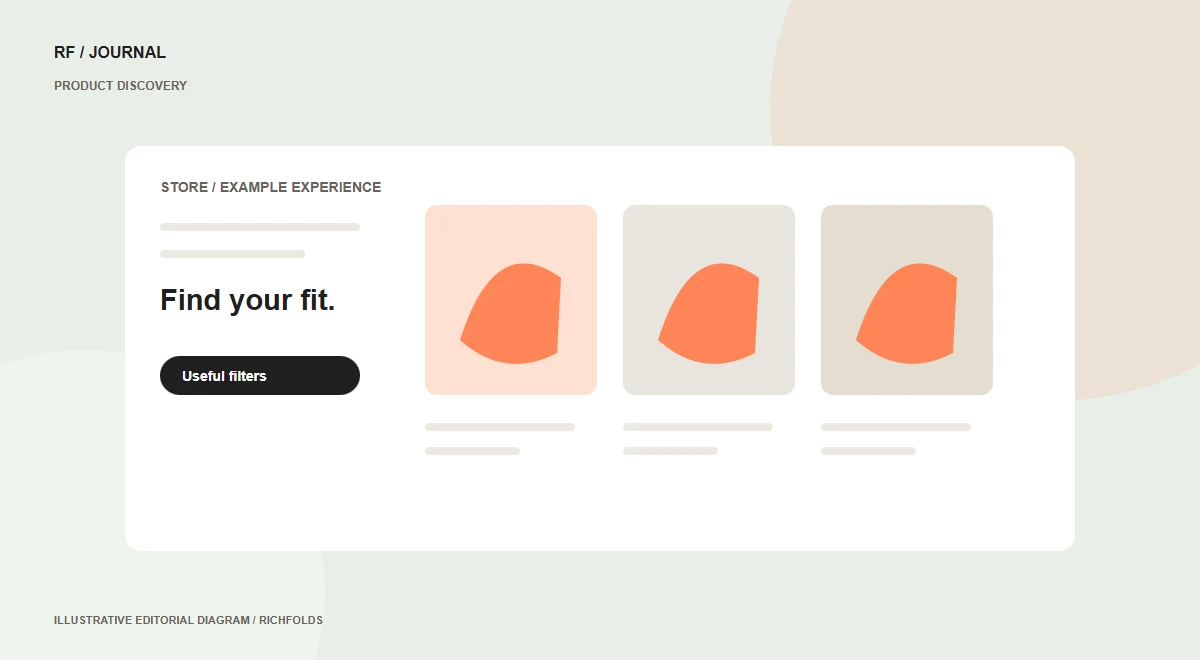
A store can have attractive photography and still make shopping difficult. Customers may not understand the categories, filters may hide important choices, or similar products may be hard to compare. Before planning a visual redesign, inspect how someone moves from a broad need to a product they can confidently buy. That journey reveals requirements a new visual style alone cannot solve.
Implementation guide: an example audit and build approach. No client conversion uplift is claimed.
Start with customer questions
Review support messages, search terms and conversations with the people selling the products. Identify the words customers use for compatibility, material or use case. Those words should inform navigation and filtering. An internal merchandising structure is not necessarily a helpful customer-facing structure, especially when buyers are unfamiliar with the catalog.
Create a useful category journey
Category pages should help visitors narrow a decision. Provide concise context, meaningful product groups and filters based on available attributes. Keep active filters visible and easy to remove. Test combinations returning no results and explain how the shopper can recover. A product count does not replace a clear route through the assortment.
Treat product data as part of the experience
Filters only work when the underlying information is consistent. Normalize units, variant labels and attribute names before adding interface controls. In an example implementation, we would audit a catalog sample, agree a shared data structure and test several difficult products. The cleanup can support category pages, search and comparison.
Evaluate search and comparison
Test common queries, misspellings, broad terms and out-of-stock products. Check whether shoppers can distinguish similar items without opening several tabs. Useful comparison information includes dimensions, compatibility, delivery requirements or intended use. AI-assisted search should be judged against the same practical shopping tasks as conventional search.
Measure the complete journey
Track movement from category or search pages to product pages, carts and completed orders. A change might increase browsing while making the purchase decision harder. Combine analytics with short usability sessions to understand hesitation. Implement a focused improvement, record the data and interface changes, and evaluate the outcome before adding another layer of complexity.
Continue reading
Sources & further reading
Published 13 October 2026. Check current platform documentation before implementation.