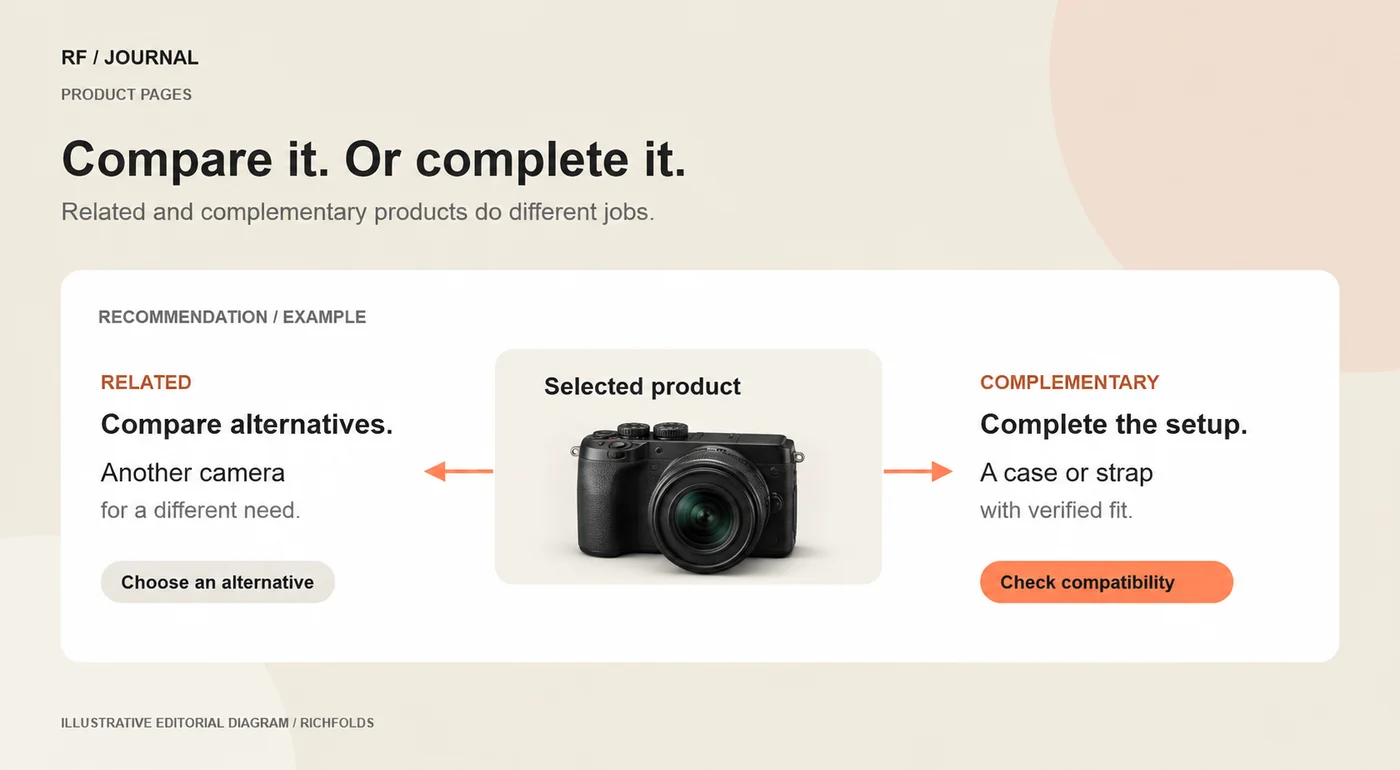
A product recommendation should help the customer make a useful decision. Related products usually offer another option; complementary products support the item the customer is already considering. Decide which job the recommendation needs to perform before selecting products or changing the storefront.
A replacement filter and an alternative filter are different recommendations. One completes the purchase; the other changes it. Treating them as interchangeable can make a product page harder to understand.
Separate the two shopping tasks
Start with the relationship between the products. A compatible accessory may be a sensible complement. A similar product with a different capacity may be an alternative. Ask whether a shopper should compare the items or use them together.
In an illustrative camera catalog, a compatible case could be complementary, while another camera model could be related. Compatibility must come from verified product information. A visually similar accessory is not enough evidence that it fits.
Review how recommendations are provided
Shopify Search & Discovery supports customizing recommendation choices, subject to the documented storefront requirements and product eligibility rules. Review those rules and the theme implementation before assuming that every selected item will be displayed.
Use administrative controls to support a merchandising decision rather than bypassing catalog accuracy. Check product status, availability and the attributes necessary to understand the relationship. If the catalog changes frequently, establish a review process so a recommendation does not become outdated unnoticed.
Explain the relationship on the page
A heading such as compatible accessories can be clearer than a generic you may also like label when compatibility is the reason for the selection. Keep the language accurate and concise. Where the relationship needs explanation, provide enough context to avoid an incorrect purchase.
Do not label a paid placement as a personal recommendation without appropriate disclosure. Do not fabricate popularity, customer ratings or claims that other shoppers bought the combination.
Check presentation and failure cases
Preview the feature on a representative set of products. Include products with no suitable recommendations, unavailable accessories and similar items that must not be presented as compatible. Verify that the page remains useful if no recommendation can be shown.
On mobile, check whether the extra section helps the visitor or pushes important product information too far down the page. The recommendation should complement the decision rather than interrupt it.
Evaluate the outcome
Measure more than recommendation clicks. Review what happens to product selection, cart contents and completed orders, while checking returns or support questions where relevant. An increase in accessory clicks does not establish that customers made better purchases.
If you run an experiment, define the hypothesis and decision metric first. The A/B testing guide explains that planning process. For a broader catalog review, start with product discovery.
The next step is a small, accurate recommendation set with a named merchandising owner. Expand after the team can maintain it and evaluate its effect.