
AI search has given website owners a new version of an old question: how do we become the answer somebody trusts? The vocabulary now includes answer engine optimization, or AEO, and generative engine optimization, or GEO. The useful work still starts with the customer's question and the evidence on the page.
For a business website, build an AI search visibility plan around clear information, reliable access, supporting evidence and measured outcomes. Do not buy a guaranteed citation or assume that a new file or schema type will make an AI system recommend the business.
This article offers a practical editorial and measurement framework. It does not claim RichFolds achieved a ranking improvement or tested every AI search product. Official guidance was checked on 18 October 2026; interfaces, reporting and availability can change.
Separate access, inclusion and business value
A page can be technically available without being selected for an answer. It can be cited without receiving a visit. It can receive visits that never become useful enquiries. These are different stages and need different evidence.
Google's guidance for AI features says existing SEO practices remain relevant, with no special additional optimization required for AI Overviews or AI Mode. Eligibility does not guarantee indexing or appearance. That gives a sensible starting point: improve the actual website before chasing an invented shortcut.
Keep three questions visible in the project brief. Can the relevant system access the intended page? Does the page answer the question accurately? Can the business observe a useful result? A failure at one stage should not be disguised by a positive number from another.
For example, a citation report cannot establish that a customer completed a quote request. An enquiry increase cannot establish that AI answers caused it. Keep observations separate from explanations until the evidence supports the connection.
Begin with customer decisions, not a list of fashionable keywords
Consider a fictional commercial photography studio. Its customers need to know what the service includes, which locations it covers, what files they receive and what affects the quote. A page saying the studio delivers exceptional visual solutions does not answer those questions, however elegantly the words are arranged.
Collect questions from approved enquiry records, sales conversations and the existing website. Remove private details before using examples. Group questions by the decision they support, such as service fit, preparation, process, cost factors and aftercare.
Choose a page owner for each group. If pricing depends on scope, explain the factors and the information needed for an estimate. Do not invent a starting price for the sake of giving a search system a neat number.
Prioritize questions that repeatedly delay a customer's next step. A small number of complete, maintainable pages can be more useful than a large collection of thin posts that paraphrase the same question.
Give the page a direct answer with boundaries
Put the central explanation near the beginning. Then add conditions, examples and the next action. The page should help a reader who arrived directly, without requiring them to decode the homepage first.
For the photography example, a useful answer might explain that the quote depends on locations, shot requirements, usage and production needs. It would tell the customer what to send and identify which details require discussion. This is a fictional content approach, not a statement about a real studio's commercial terms.
Avoid turning every paragraph into an FAQ. Use headings that match the actual content and tables when they clarify a comparison. A service boundary deserves an explanation, not twenty near-identical questions written to occupy more search results.
Keep important facts in accessible text rather than only inside images. Images can demonstrate the service, but a graphic with tiny embedded words should not be the sole place a customer can find a key condition.
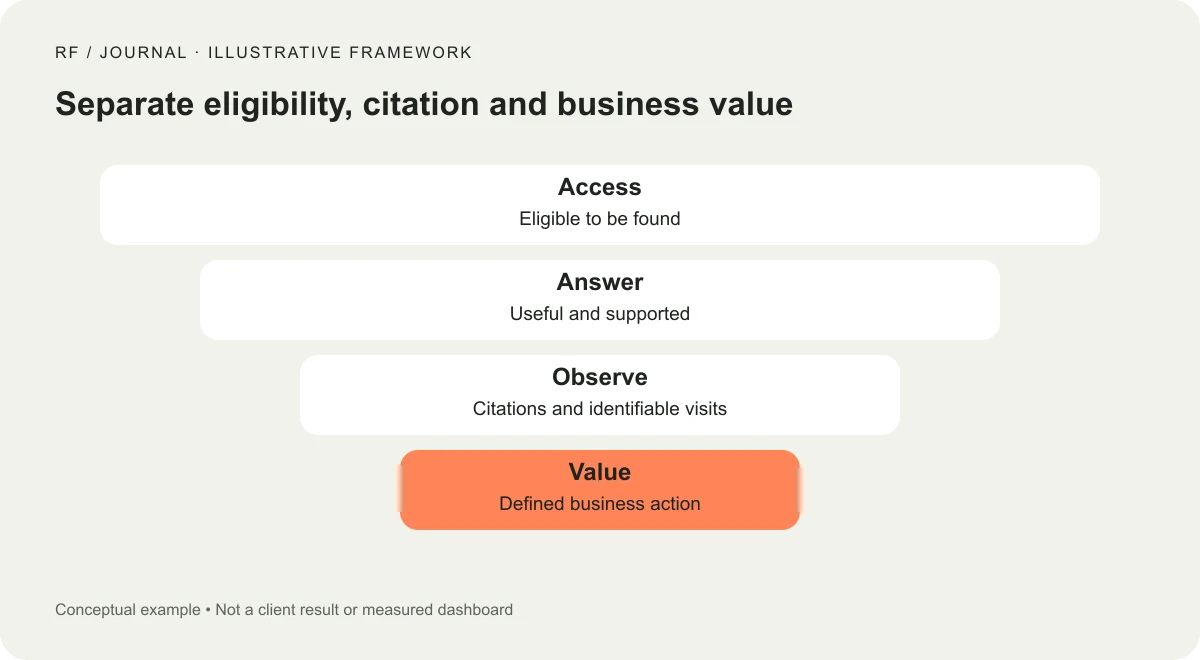
Conceptual measurement framework, not an actual search or analytics dashboard.
Add evidence that belongs to the claim
If a page describes a process, show the process accurately. If it includes a case study, explain the work, the conditions and what was measured. Keep a measured transfer-size reduction separate from a claim about conversion or revenue.
Use real project images only with the appropriate rights and permission. Label illustrative images clearly. A generated mockup can explain a proposed interface, but it should not masquerade as a delivered client result or a customer testimonial.
For time-sensitive statements, assign a review trigger. A platform feature may change, a service area may expand and a business policy may be replaced. A page owner should know when the content needs checking rather than relying on a decorative updated date.
Credibility is also consistency. The service page, contact details and linked policies should agree. A clear answer loses value if the next page contradicts it. Treat those inconsistencies as content defects with an owner and a correction.
Check technical access without changing policy accidentally
Inspect the intended public URL, its response, canonical destination and indexing controls. Confirm that important content is present in the delivered page and linked from relevant parts of the site. Review errors and unintended redirects before experimenting with additional formats.
Do not assume every crawler has the same purpose. Search access, AI answer retrieval and model-training controls can differ by provider. Review the relevant official documentation before changing robots rules or site policies. A broad block can affect something the business intended to keep available.
Likewise, do not add unsupported structured data simply to look optimized. Describe what is actually visible and appropriate for the page. A fictional review, invented rating or misleading product field is not an acceptable visibility technique.
For ecommerce, keep product facts consistent across the storefront and connected systems. Our AI shopping product-data guide addresses catalog readiness in more detail. A search-friendly description cannot repair contradictory availability or an unclear variant relationship.
Build a small observation set
Choose a manageable set of customer questions and record why each matters. Include a mix of service fit, comparison, process and practical preparation. Record the exact wording, market, date and product surface when observing results.
AI responses can vary. A single answer seen on one device is an observation, not a permanent ranking. If you repeat a check, keep the method consistent and note changes instead of quietly replacing an inconvenient result.
Record the answer's accuracy as well as whether the brand appears. A mention containing an outdated service claim may require a content correction or investigation. More mentions are not automatically a better outcome.
Avoid producing a theatrical visibility score from a tiny sample. A useful report might simply show which questions were checked, which pages appeared, what was inaccurate and what changed after an update. The limitations should be easy for the client to understand.
Use platform reporting for the question it can answer
Bing's AI Performance documentation describes reporting on citations, cited pages and grounding queries across supported AI experiences. Such reporting can help identify which content is being used. Confirm the current report and available data in the actual account before including it in a client deliverable.
Citation activity is not a traffic count or a sales total. Keep it in a separate part of the report. Use the platform's own definitions rather than relabeling a metric to make it sound more commercially impressive.
Google's documentation places AI-feature traffic within overall Web reporting in Search Console. Avoid promising a precise AI-only acquisition segment that the available data cannot establish. Analytics referral information also has limits and should not be treated as a complete record of every AI-influenced visit.
The practical output is a layered report: observed visibility, visits where identifiable and business actions with a clear definition. Missing attribution stays missing; it should not be filled with an optimistic estimate presented as fact.
Define the business action before measuring improvement
For the fictional studio, a useful action might be a completed, relevant project enquiry. Define what counts and how duplicates, spam and test submissions are handled. A button click alone may not represent an actual request.
Confirm that the measurement works before comparing periods. If a form stops recording submissions, a traffic chart cannot rescue the conclusion. Our measurement setup guide explains why event definitions and verification come before interpretation.
Annotate meaningful changes: content revisions, campaigns, site releases, service changes and tracking corrections. If enquiries rise after several changes, do not attribute the whole difference to the AI visibility work.
Use directional observations honestly. A content update can make the page clearer even when the available sample is too small to establish an acquisition effect. Reader usefulness is a valid reason to correct confusing information without inventing a statistical result.
Run one focused improvement cycle
Pick a page with a known customer question and an identifiable information gap. Capture the existing page and the reason for changing it. Write the improved explanation, verify its claims and check the related contact or purchase route.
After publication, confirm the live content, links and indexing controls. Record the date of the actual change. Then observe the agreed questions and business measures over a suitable period for the site, without promising a universal deadline for inclusion.
At review, separate completed work from observed effects. “Clarified the service scope and added a preparation checklist” is a deliverable. “Observed a citation for this question on this date” is evidence. “Generated more revenue” needs a much stronger basis.
If the page still fails to answer the question, improve it again. If the answer is strong but visibility is sparse, inspect access, competition and the observation method. Do not respond by publishing multiple versions of the same page with slightly different titles.
What to ask an AEO or GEO provider
Ask which customer decisions the work will support, which pages will change and what evidence will appear in the report. Request clear definitions for citations, impressions, visits and conversions. Ask what the service cannot measure.
Be cautious about guaranteed placements or secret technical requirements that contradict current platform guidance. A useful provider can explain the work in terms the client understands and show a concrete page improvement.
The next step is small: choose one important question and inspect the page that should answer it. Make that answer clearer, more accurate and easier to verify. Then measure what actually happened, keeping the uncertainty visible. That creates a useful search program even as the names and interfaces continue to change.
Keep discoverability work separate from performance evidence with the Core Web Vitals action plan.