AI becomes useful when it removes a repeatable piece of work without making the rest of the process harder to trust. For a content team or online store, that might mean preparing a product-description draft, finding an approved support answer or organizing an incoming brief. Start with a task that has a clear owner and a result somebody can evaluate.
Implementation guide: a proposed workflow, not a claimed client deployment or measured client result.
Choose a task with a clear boundary
Look for work that happens frequently and follows recognizable rules. Drafting a description from verified product attributes is a practical first experiment. Write down the inputs, expected output and the checks a person must make. If nobody can explain what a good result looks like, define the workflow before selecting a model.
Keep the source of truth outside the prompt
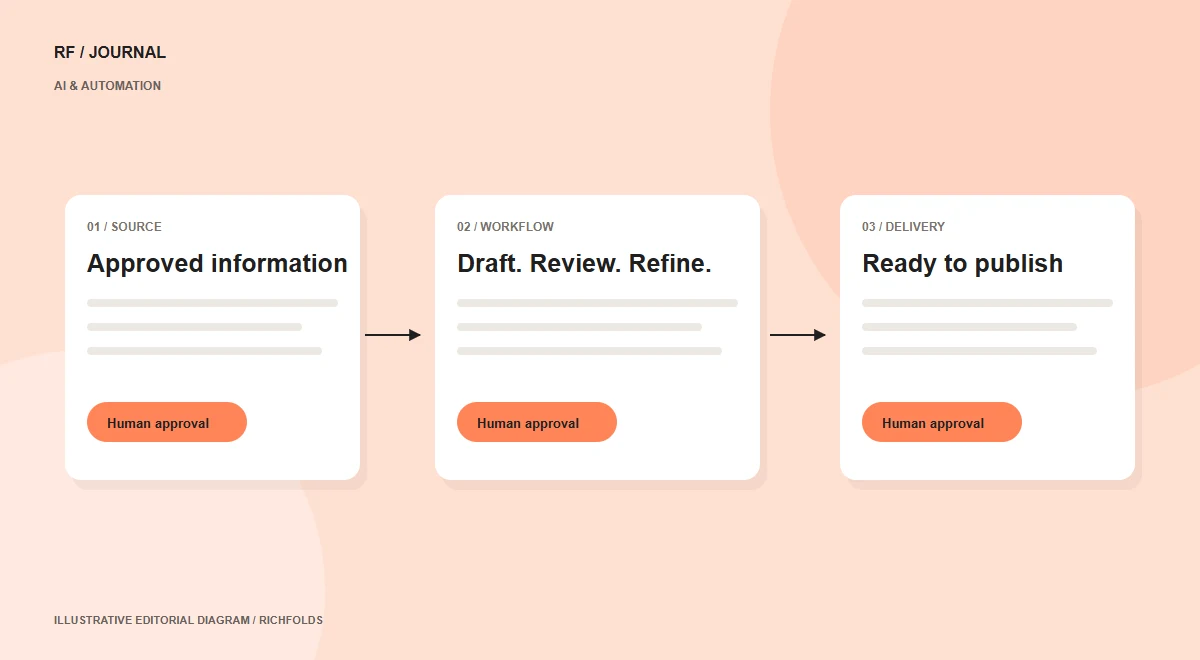
The product database, approved knowledge base or CMS remains authoritative. An AI system can retrieve and transform information, but it should not invent specifications or delivery promises. In an example content workflow, we would pass approved features, tone guidance and prohibited claims to the model. Its response enters a draft queue rather than publishing immediately.
Design review into the implementation
Editors should be able to compare the draft with the original facts, reject an answer and see which information was used. Store the approval decision and the version that was published. Keep the normal editing process usable if the AI service is unavailable. Define which users can generate drafts and which users can approve customer-facing content.
Measure the complete job
Count the time spent generating, checking and correcting the result. A quick draft does not save time if the reviewer rewrites every sentence. Track acceptance rate, recurring errors and cost per approved output. Test easy examples, missing information and difficult terminology. Repeat the evaluation when prompts, source content or models change.
Start with a controlled pilot
- Select one task and one team.
- Use approved, non-sensitive examples for the initial evaluation.
- Define who reviews and who publishes.
- Compare the reviewed result with the existing process.
- Expand when the team can demonstrate a useful improvement.
Check built-in tools before commissioning an integration. Shopify documents content and task assistance in Sidekick; custom development should address an additional requirement.
Continue reading
- Shopify Sidekick: practical AI capabilities to evaluate in your store
- How to choose a CMS around the way your team works
Sources & further reading
Published 13 October 2026. Check current platform documentation before implementation.