Shopify describes Sidekick as an AI-enabled assistant within the store admin. Documented capabilities include guidance, content generation and assistance with store tasks, with changes presented for review. For a merchant, the useful question is which capability fits an existing job—and how to evaluate its output before relying on it.
Capability briefing checked on 13 October 2026. This is not a claim of a release announced today or a completed client rollout.
Connect a capability to a real task
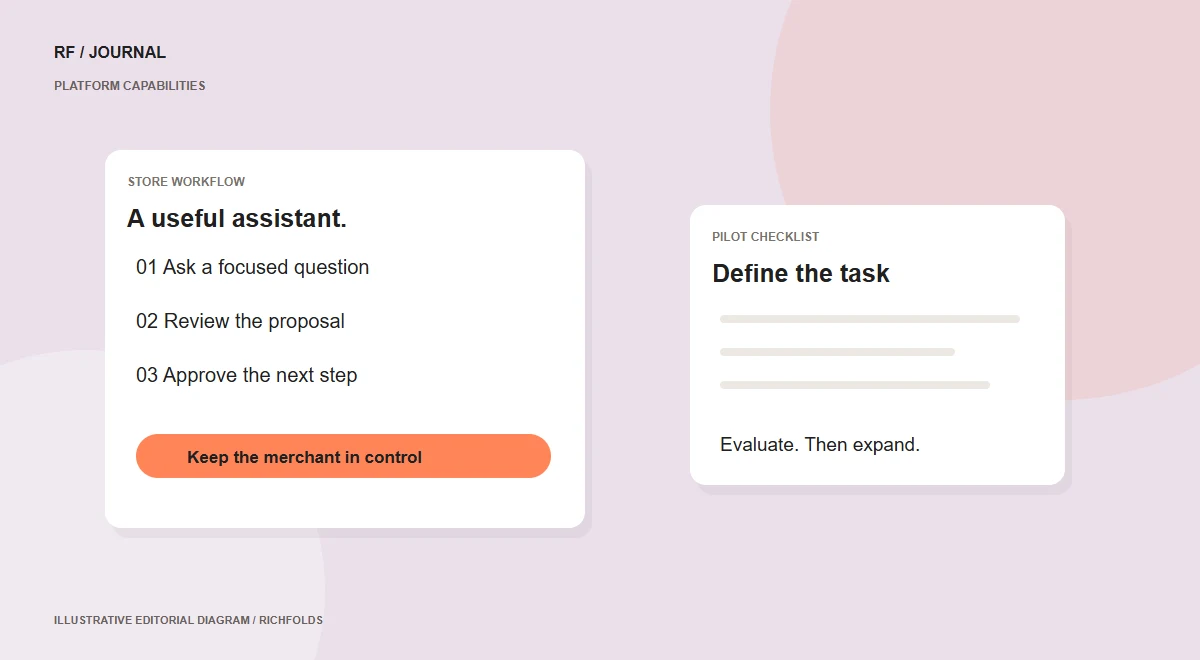
Begin with one repeatable activity: preparing a product description, investigating a store question or creating a small administrative tool. Document how the team completes the task today, the information it needs and decisions a person makes. This baseline separates a useful improvement from a demonstration that looks impressive but does not reduce work.
Check availability and permissions
Review current Shopify documentation and the actual store interface before promising a feature to a client. Confirm that the staff member can access the workflow and that the action fits their responsibilities. A vendor demonstration still needs evaluation against the store’s catalog, connected applications and operating process.
Pilot content with an approval checklist
Provide verified product facts and a clear tone requirement. Review for invented attributes, unsupported claims, incorrect terminology and missing information. Keep the first pilot in draft content. Ask the editor to record corrections and reasons. Measure the effort needed to produce an approved result, not simply the speed of the initial response.
Keep accountability clear
The merchant remains responsible for approved changes. Document appropriate assistant actions and which decisions need another process, particularly when they affect product data or customer-facing promises. Keep existing manual workflows available. Uncertain output should lead to review, not become a silent store change.
Decide whether custom development adds value
A built-in workflow may meet the requirement. If it does not, describe the missing integration or business rule before planning a custom solution. Evaluate an integration against input quality, review effort, failure behavior and operating cost. Choose an approach the client understands and can maintain. A well-scoped pilot creates better evidence than an ambitious rollout without a baseline.
Continue reading
- Practical AI workflows for CMS and ecommerce teams
- Improve product discovery before redesigning your store
Sources & further reading
Published 13 October 2026. Check current platform documentation before implementation.