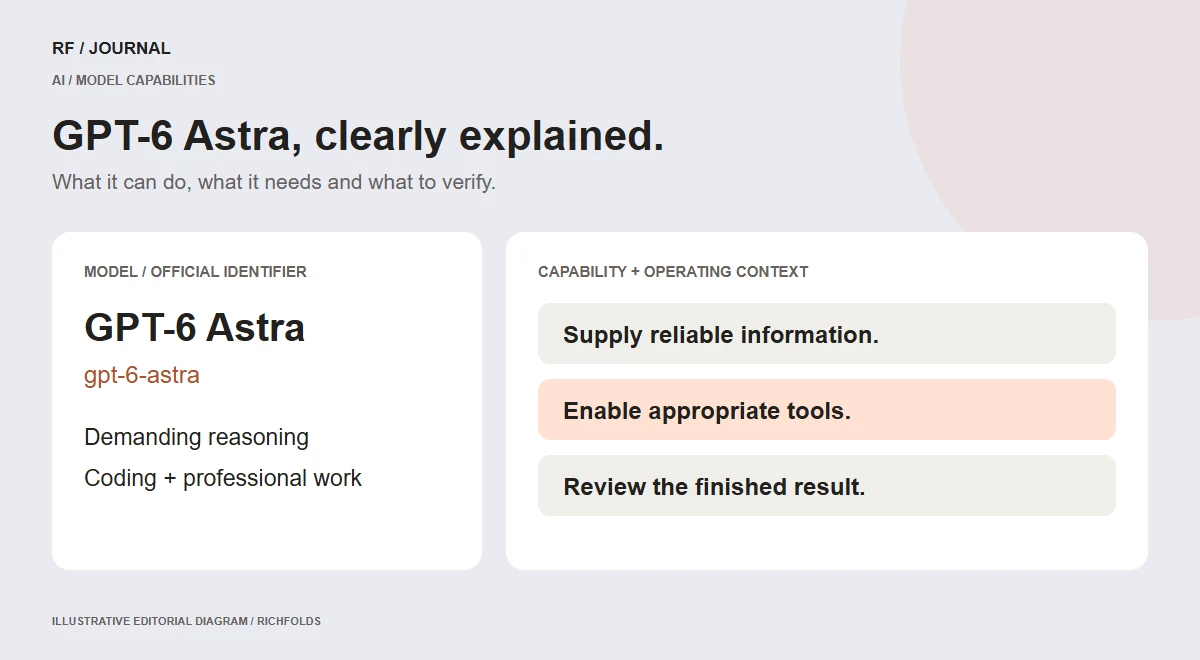
GPT-6 Astra is OpenAI’s model for demanding reasoning, coding and professional work. Its API identifier is gpt-6-astra. The clearest way to understand it is to separate the model’s abilities from the application, tools and information surrounding it.
Astra can help work through a complicated website requirement, inspect supplied images, reason about code and participate in tool-supported tasks. It does not automatically have your website files, customer records or permission to change production. Those capabilities come from the environment you connect and the boundaries you establish.
For a business owner, this distinction makes the discussion more useful. Instead of asking whether Astra can build a website in the abstract, ask what information it receives, what it may do and how the result will be verified. This article answers those questions with proposed CMS and ecommerce examples. It is not a product benchmark or a claim of measured client results.
The facts behind the name
The official model page lists text and image input, text output, a 1,050,000-token context window and a maximum output of 128,000 tokens. Its stated knowledge cutoff is 30 April 2026. Native audio and video are not listed as supported modalities.
Those specifications were checked on 14 October 2026. They describe the API model, not an entitlement to every feature in every application. A product can impose its own access, usage and tool configuration rules.
A large context window means a request can carry substantial material within the relevant limits. It does not mean every submitted document will be interpreted correctly, that a whole project should be uploaded indiscriminately or that the model knows information published after its cutoff without retrieval.
That last point matters when researching platform updates. For current facts, use an appropriate search or retrieval workflow and verify the supporting sources. A confident answer from memory is not evidence of today’s availability.
Astra, Codex and tools are different layers
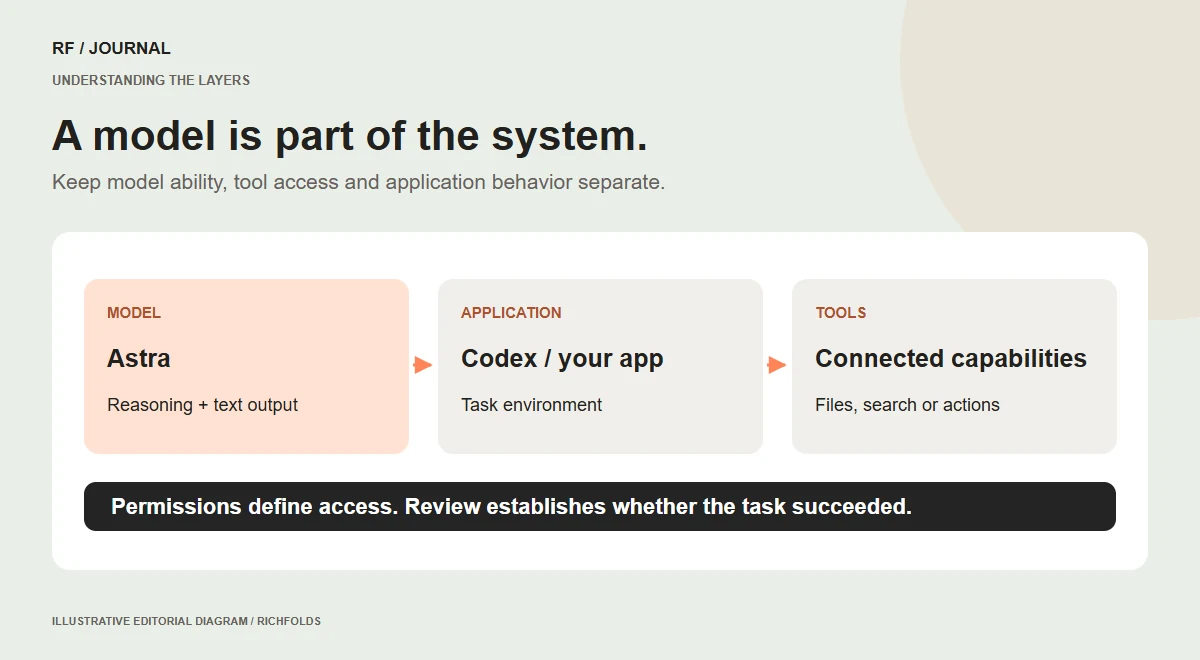
Astra is a model. Codex is an agentic product environment that can use supported models to work with a project. Tools provide particular capabilities, such as retrieving a page, inspecting files or running a permitted command. Permissions determine what an agent may actually do in the selected environment.
Consider an illustrative bug in a WordPress theme. The model needs the relevant code to reason about the issue. A file tool supplies access to that code. A command tool may let the environment run a suitable check. The project instructions explain conventions and scope. The release process determines whether an accepted change reaches the live site.
None of these layers should be assumed from the word Astra alone. A chat that returns suggested PHP is different from a configured coding environment that edits a file and reports a test result.
This distinction also prevents exaggerated proposals. A model-supported demonstration can show how a task might work. A production integration still needs a data contract, failure handling, access control and an owner.
Reasoning effort is a task setting, not a quality guarantee
OpenAI’s GPT-6 guide describes reasoning-effort choices including low, medium, high, xhigh and max for Astra. It does not support the none effort level. Choose a setting based on the work and evaluate the result.
More reasoning may be worth considering when a task contains interacting constraints: preserving a checkout integration while changing an interface, reconciling conflicting requirements or diagnosing a failure across several components. It does not make missing business information appear.
For a straightforward formatting change, the team may not need the same configuration used for a difficult architecture review. Compare completed tasks, including correction and review time, rather than assuming the highest setting is always the best use of the budget.
Give the model an explicit result to produce. A request to explain the conflict between two shipping rules is more reviewable than a request to think deeply about the store. The first has evidence and a decision attached; the second can produce a long answer without resolving anything.
Coding: useful when the requirement is concrete
Astra’s coding role is most understandable through a bounded change. Suppose a service card becomes crowded because shared typography interacts with a shrinking layout. The useful task is to identify that interaction, propose a focused adjustment and check the affected screen sizes.
A developer should supply the real markup, styles and project constraints. Ask the assistant to explain the cause before making a large rewrite. A generated replacement section can look impressive while ignoring reusable behavior or creating inconsistent styling elsewhere.
Review the code difference and the visitor experience separately. A valid file does not prove that long text fits on mobile. A successful screenshot does not prove that a form still delivers to its intended destination.
This is a proposed implementation pattern, not evidence that Astra has passed a particular theme test. The team needs actual checks in the intended environment before reporting the change as complete. Our Codex delivery article explains the surrounding review process.
Image understanding: inspect what is actually supplied
Image input can be useful for discussing an interface screenshot, a diagram or a photographed document. The model can receive visual information as part of its context, but the team still needs to check whether it interpreted the important detail correctly.
For an illustrative product-page review, supply a screenshot and ask what information is visible before adding an item to cart. The result may help identify a missing size explanation or an unclear selected option. It does not establish that every customer will experience the same page or that a redesign increases conversion.
Keep descriptions grounded in the image. If small text is unreadable or a control is outside the crop, mark the limitation instead of treating it as absent from the whole website. Use the real page or underlying content for details the screenshot cannot establish.
Image understanding is also different from image generation. Astra can work with a supported image-generation tool in an appropriate environment, but its native output modality remains text. A pipeline generating a realistic article illustration has additional tool behavior, costs and editorial checks.
Research and documents need a source contract
The model page lists supported tool capabilities such as search, file search, code interpretation and computer use through the Responses API. A supported capability still needs to be enabled and configured in the actual application. It is not universal access to every service or document.
For a proposed CMS requirements review, identify the approved documents and which one governs each fact. Ask for a claim ledger with source locations, conditions and unresolved questions. Do not ask the assistant to hide contradictions by producing a smoother summary.
A service scope might differ between an old sales presentation and the current approved brief. The model can help surface that difference, but the business owner must decide which commitment belongs on the public page.
For current research, retain direct links supporting the important statements. A search result can help locate information; it is not automatically sufficient evidence for a claim. Read the source and check whether it describes the same product, plan and date the article discusses.
A client-work example: product compatibility
Imagine a store selling replacement parts. Product sheets contain dimensions and supported equipment families, but the storefront uses inconsistent names. Customers cannot easily determine which part fits their equipment.
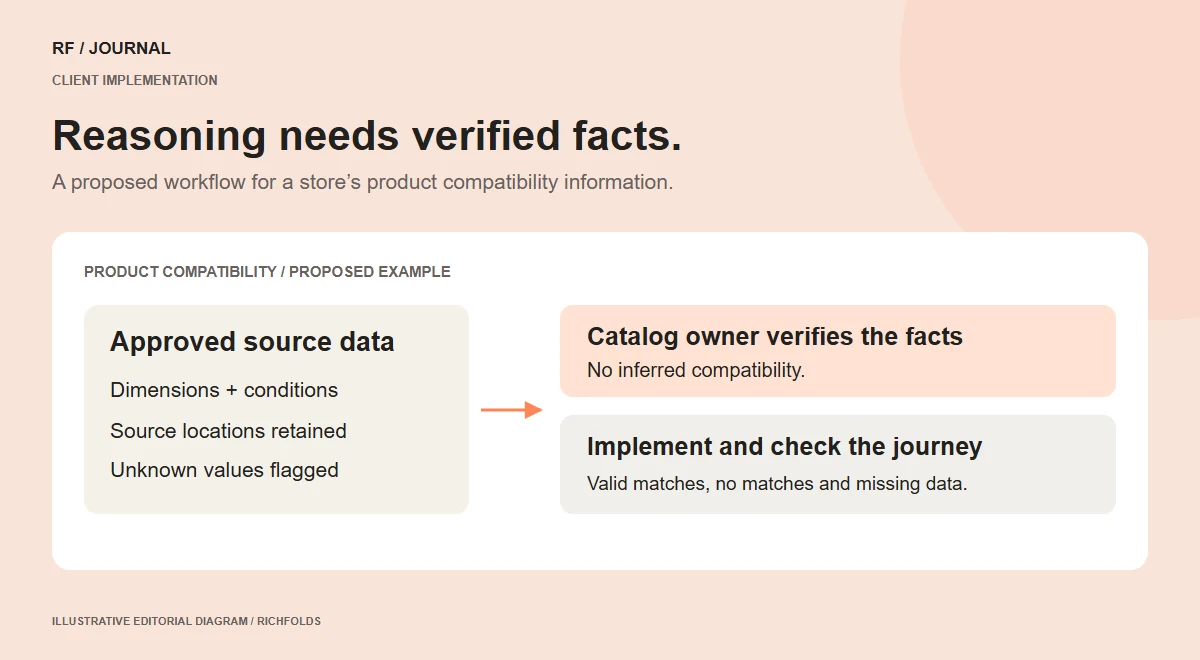
A proposed Astra-assisted workflow begins with approved product information and a defined extraction format. Ask the model to organize compatibility facts, keep the conditions attached and flag missing or contradictory values. Do not let it infer compatibility merely because two product names look related.
The catalog owner reviews the resulting records. Once the values are confirmed, the implementation team can propose filter labels or a compatibility section. The model may assist with that code, but the storefront needs checks for valid matches, no matches and incomplete data.
This example shows where reasoning and implementation can connect. It also shows the boundary: a useful model suggestion is not a verified product specification. The product discovery guide provides the wider buying-journey context.
API costs: distinguish a rate from a project budget
At the research date, the official API pricing lists Astra’s Standard text rates as $10 per million input tokens and $50 per million output tokens. Cached input has a separate rate. Processing tiers, tools and long-context conditions can change billing.
Here is an illustrative calculation, not a measured request: 20,000 uncached input tokens at the stated Standard input rate cost $0.20; 5,000 billable output tokens at the stated output rate cost $0.25. That totals $0.45 for those token components only.
It is not a quote for a completed website task. Additional requests, billable reasoning, tool use and review work can change the total. A ChatGPT or Codex subscription is also a different billing arrangement from these API unit prices.
OpenAI documents higher rates for prompts above 272,000 input tokens, so a large context allowance should not be read as a flat-price promise. Check current billing guidance before sizing an application around long requests.
Budget for an accepted result, not only the first response. If the assistant needs repeated clarification or a reviewer must reconstruct its evidence, the operational cost can exceed what a token-rate comparison suggests.
When another model may be the better starting point
OpenAI’s current family guidance positions Astra for demanding work, GPT-6.1 Sol for a balance of capability and cost, and Luna for focused high-volume tasks. That positioning is a starting point for evaluation, not an independent ranking of your workload.
A simple content classification task does not necessarily need the same configuration as a difficult integration review. Equally, selecting the cheapest model can be a poor decision if the result requires extensive correction or cannot satisfy the requirement.
Prepare a few representative tasks and define acceptance criteria first. Compare correctness, useful detail, review effort, latency and total task cost. Include a case where the correct answer is uncertainty or escalation.
Keep the business rules and evidence independent of the provider configuration. That makes a later model change easier to evaluate without rebuilding the project’s knowledge from a chat history.
What has changed, and what is not confirmed
The official API changelog records Astra’s release on 3 September 2026 and an Ultrafast mode addition on 29 September. Speed-mode behavior, pricing and regional processing restrictions should be checked before choosing them for an application.
Do not confuse a faster generation mode with a guarantee that an entire project finishes faster. File access, external services, human decisions and verification can still determine the total duration.
We did not establish a dated future Astra successor from the sources used here. A rumored model name or a prediction about the next release should not be presented as confirmed news. Monitor the official changelog for changes that affect the task you already run.
Update the article when an important specification or availability condition changes. Retain the research date so readers can distinguish current documentation from an older capability briefing.
A sensible first project
Choose a task whose outcome can be inspected: a bounded component fix, a requirements review or an approved information-extraction job. Give the assistant the necessary context and a clear boundary. Define how success and failure will be recognized.
Run the work in the appropriate environment, review the output and record the checks actually completed. Keep proposed improvements separate from measured results. If the assistant identifies a missing fact, resolve it with the responsible person rather than prompting for a more confident answer.
Astra is most useful when its reasoning connects with dependable information and a reviewable delivery process. Start there, then decide from evidence whether a broader integration is justified. Our AI adoption plan explains how to compare that workflow with other options.
Research checked on 14 October 2026. Capability availability and billing vary by product, account and configuration. The examples are proposed workflows, not measured client results.