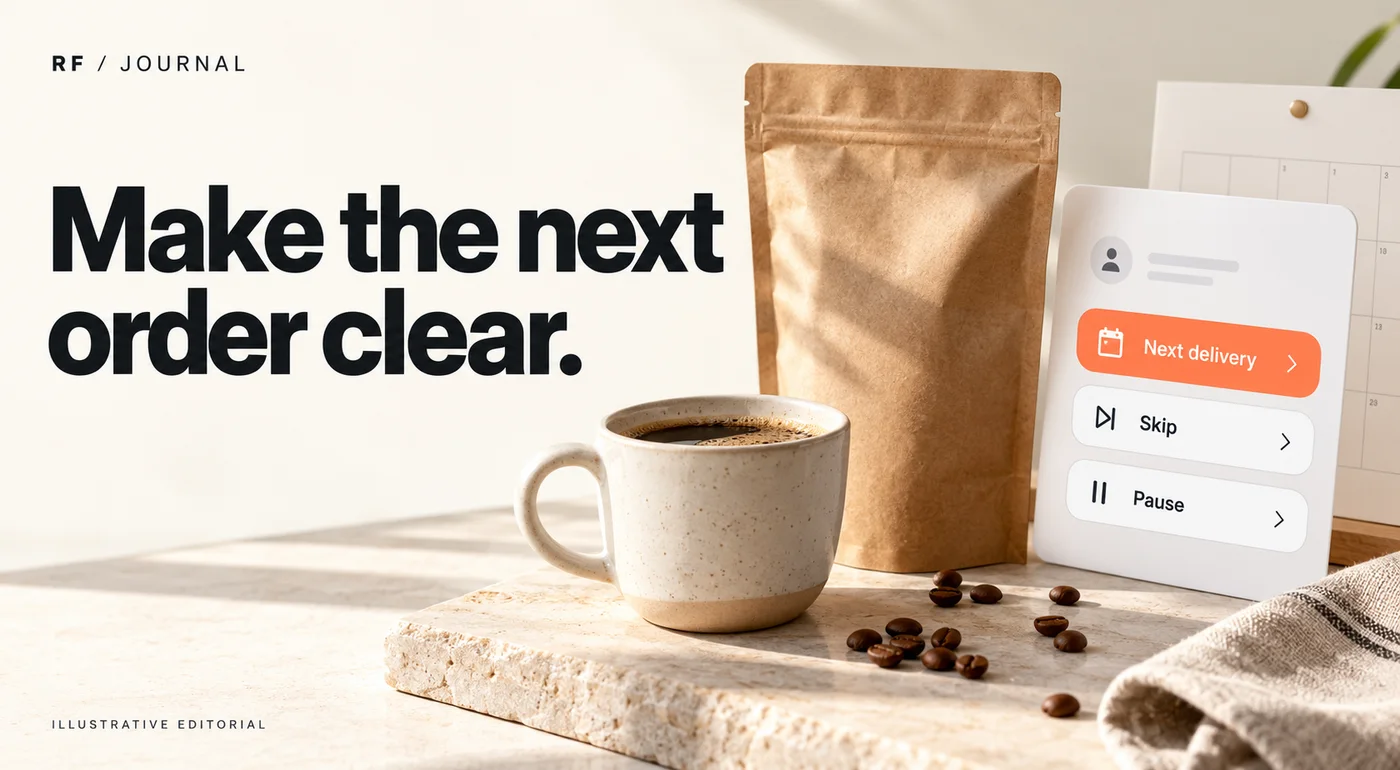
The first subscription order gets the beautiful product page. The second order gets the real questions: Why was I charged today? Can I skip this delivery? I moved last week. Where do I change my card?
Plan those moments before adding the subscription offer. A useful implementation connects the purchase, reminder, customer account, payment recovery and support process. The recurring charge is only one part of the service.
This article focuses on the customer journey around Shopify's first-party Subscriptions app. Other apps can behave differently. Documentation was checked on 22 October 2026; the coffee examples below are fictional and no live subscription testing is claimed.
Describe the recurring promise in ordinary language
Write the offer without using the app's settings as the explanation. A customer needs to understand what arrives, how often it arrives, how the charge works and how to make a change.
For a fictional coffee refill, the working brief might say: “One selected bag on the chosen recurring schedule, with delivery costs explained before purchase and account controls for future orders.” The real store must supply its actual schedule, terms and available actions.
Keep the one-time purchase and recurring purchase visually distinct. A small discount should not be the most noticeable fact while the repeat commitment hides in quiet text. Ask a reviewer to identify the selected purchase option without a designer standing beside them narrating the screen.
Shopify's customer-experience documentation describes frequency and subscription information in checkout, along with account actions such as updating payment details, changing an address, skipping an upcoming order, pausing and canceling. Confirm the real account setup and app configuration before treating those actions as finished features.
Build a journey around the next delivery
Use one example customer and follow the subscription through time. The purpose is to expose unanswered decisions, not to invent a customer story as evidence.
| Moment | Customer's question | Implementation evidence to collect |
|---|---|---|
| Purchase | Am I buying once or repeatedly? | Product selection and checkout review |
| Confirmation | What did I agree to? | Accurate order and subscription messages |
| Before renewal | When can I change this delivery? | Actual reminder and relevant account destination |
| Account visit | Can I skip or update it? | Correct subscription and action outcome |
| Failed payment | What should I do next? | Payment update route and support instructions |
| Cancellation | Has the recurring arrangement ended? | Status and confirmation checked together |
Make timing explicit in the working specification. An upcoming delivery, a renewal attempt and a fulfillment cutoff are different events. Support needs to know which actions can still affect the next order and which require separate intervention.
Do not put a universal cutoff in the website copy unless operations can honor it. The correct rule depends on the app, payment flow and fulfillment process. Have the business owner confirm the promise before publication.
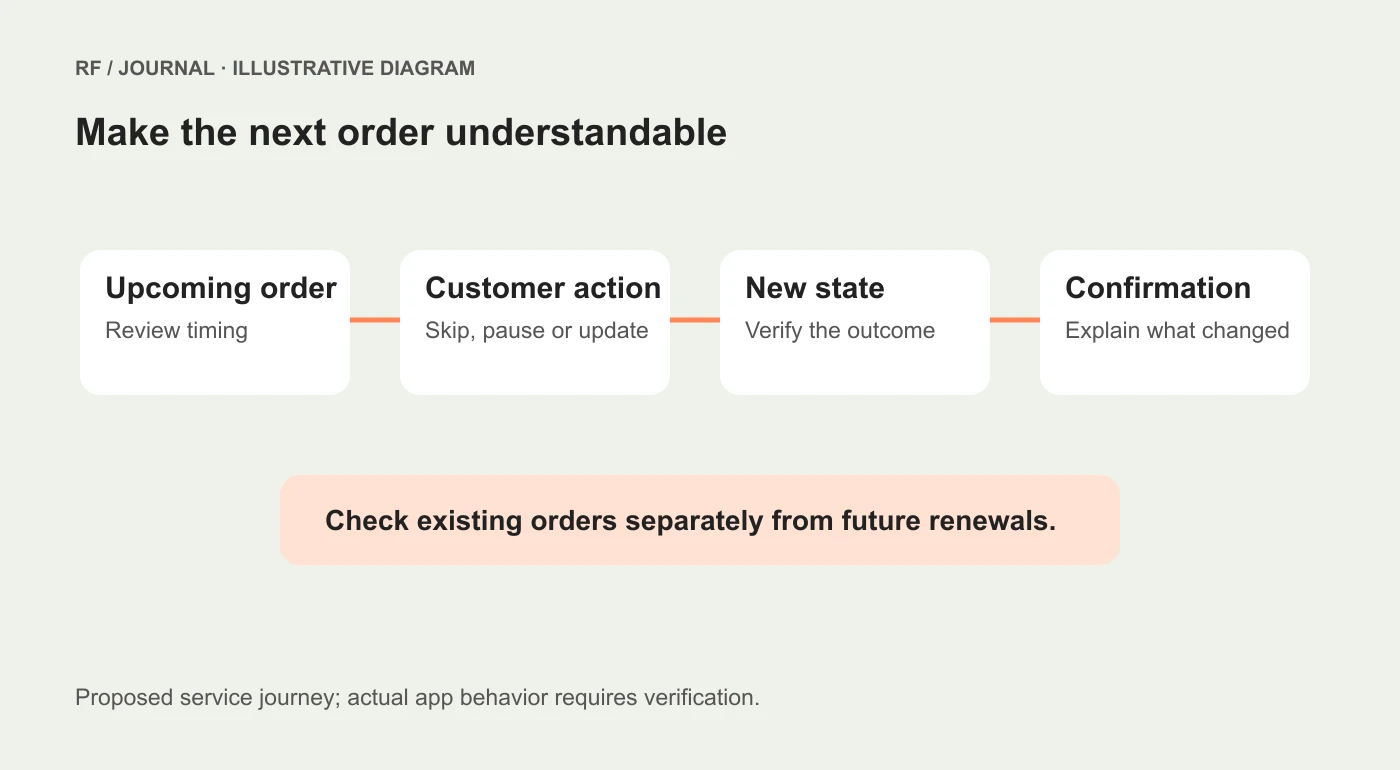
A proposed customer journey, not a screenshot of a configured subscription account.
Test the account entry point as carefully as checkout
The customer should reach the relevant subscription from the links they actually receive. Opening the account from an admin session is not an adequate test of a customer's route.
Prepare a clean test account and check these questions:
- Does the confirmation or reminder link lead to the intended destination?
- Can the customer complete the configured sign-in process?
- Is the correct subscription identifiable when the account has more than one purchase?
- Does the chosen action describe the next order clearly?
- Is there an understandable result after saving the change?
- Can the customer find help if access fails?
Also inspect the mobile journey. An action that fits comfortably beside a subscription on a desktop can disappear below a long list of order details on a small screen. The important question is whether a customer can find and complete the action, not whether the page technically loads.
Account controls are part of the product. They should receive acceptance criteria and ownership, just like the purchase button.
Distinguish pause, skip and cancellation
These words describe different intentions. A customer may want one delivery omitted, a temporary break or an end to the recurring arrangement. The interface and support explanation should not treat them as synonyms.
For the implementation review, record the expected effect of each action in the specific app. Which order changes? What remains scheduled? What confirmation is shown? What does support see afterward?
Avoid making assumptions about an already-created order. Changing the recurring arrangement and changing an order that has entered fulfillment can require different work. Test the actual boundary and explain it in customer language.
For example, a proposed support response can identify the request, confirm the relevant subscription status and separately state whether an existing order needs attention. That is more useful than a generic “All done” message that leaves the customer guessing about a parcel already being packed.
Any cancellation or renewal disclosures must also receive the business's appropriate legal and policy review. A working app control does not, by itself, establish compliance in every market.
Make failed payments a recoverable service task
A failed renewal does not explain itself. The customer needs a legitimate route to update payment information, and the team needs a way to recognize unresolved cases.
Shopify's subscription management documentation describes subscription status filters and payment-update reminders. Use those documented capabilities as a starting point, then verify how the chosen subscription app, account settings and notifications work together.
Write a proposed recovery checklist:
- Identify the subscription and affected order without copying sensitive payment details into support notes.
- Confirm the current status in the appropriate system.
- Send the legitimate payment-update route through the supported process.
- Explain what the customer should expect after updating it.
- Recheck the subscription and order state before promising fulfillment.
- Escalate unresolved cases to a named owner.
Never ask customers to email card numbers. Also avoid promising that a payment update will instantly create or dispatch an order unless the real workflow confirms that outcome.
Give customer service a short operating guide
The handover should include more than administrator screenshots. Give the team example requests and the place to verify each answer.
“I have too much coffee” might lead to a skip or pause discussion. “I changed address” requires attention to future delivery details and any existing order. “I canceled but received a parcel” requires a timeline, not a quick assumption that the account action failed.
Name the owner of the app settings, customer notifications and fulfillment rules. If those belong to different people, keep the escalation route visible. A subscription can expose gaps between teams that a one-time order never reveals.
Review the customer-facing copy whenever the operating rules change. A help page describing last month's account controls can create support work even when the new feature is functioning correctly.
Evaluate clarity before growth
For the pilot, record whether the main journeys were completed, where the reviewer became uncertain and which messages needed correction. These are implementation observations, not retention results.
After real use begins, inspect the reasons for support contacts and recurring-order problems. Keep voluntary cancellations separate from payment failures when interpreting the business outcome. They suggest different questions and different improvements.
If the project also changes delivery messaging, use our delivery estimates planning guide to keep the promise consistent. For the wider operating budget, review Shopify store costs.
Start by making the next order understandable. A subscription that customers can manage confidently has a stronger foundation than one that merely makes the first purchase convenient.
AI-assisted editorial guidance. Original illustrations are conceptual, not client evidence. Platform documentation checked 22 October 2026.