Fresh information can be useful in a website project, but freshness and reliability are different qualities. A recent social post may reveal a customer question while providing weak evidence for a product claim. A current vendor document may establish a capability without proving its value for your business.
Grok’s research and tool features deserve consideration in that context. The useful role is to help gather evidence, inspect data and support a defined workflow. It should not turn a stream of recent material into confident claims that nobody has checked.
This guide describes proposed uses in CMS, ecommerce and client research. It is not a hands-on comparison or a claim of completed deployments. Official documentation was checked on 14 October 2026, including one dated upcoming migration that may affect existing image workflows.
Current capability, not an old model summary
The current developer guide documents Grok 4.7 for coding, agentic tasks and knowledge work. It lists text and image inputs with text output. That is different from assuming the same model directly generates every kind of media available elsewhere in the product family.
The tools overview describes built-in tools, including web and X search, code execution and collections search, alongside custom function calling. Configuration and model support matter; a model’s general reasoning ability does not establish that every tool is enabled in a particular application.
For a website team, the decision is which information or action the workflow needs. A research task may need search and source retrieval. An application feature may need a carefully defined custom function. Avoid adding tools merely because they are available.
Use web and social research for different questions
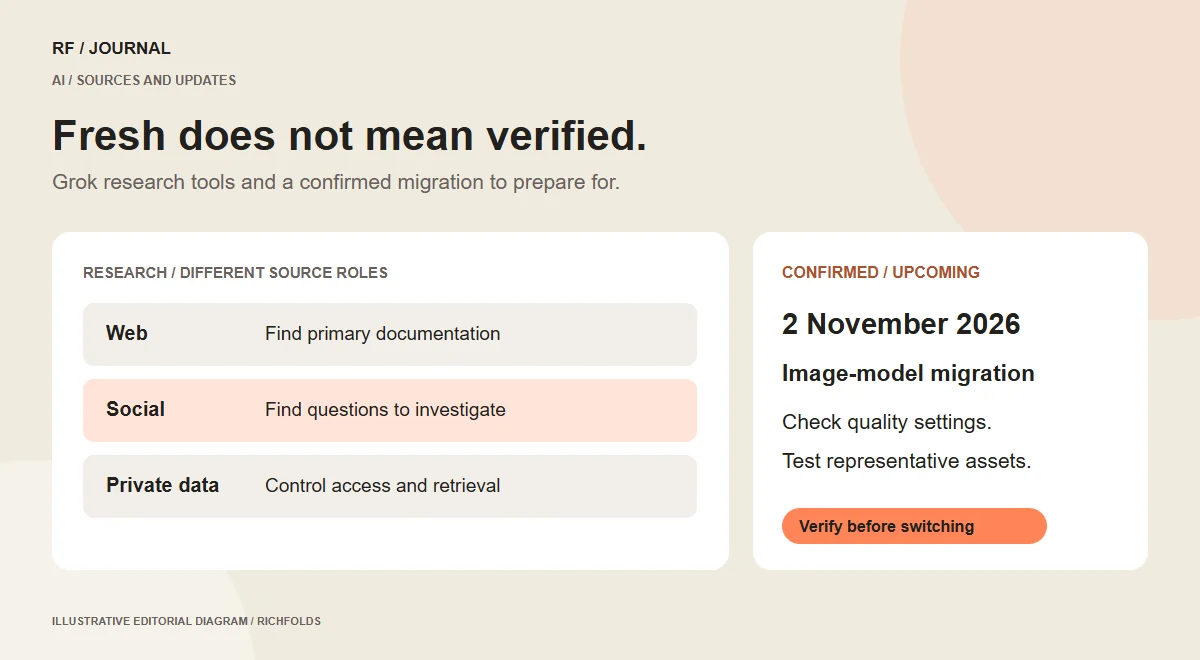
Web research can help locate official documentation, public policy pages and relevant announcements. Social research can surface current conversations, recurring questions and language people use. These sources should not be treated as interchangeable evidence.
For an illustrative ecommerce discovery project, social posts might suggest that shoppers are confused about a product’s compatibility. That is a useful hypothesis to investigate. It does not establish the product’s specification or the proportion of all shoppers experiencing the issue.
Confirm factual claims against the appropriate primary source. Preserve the date and context of a conversation when reporting it. A complaint about a discontinued product should not silently become a claim about the current catalog.
Define the research question before searching. Otherwise a tool optimized to find fresh material can produce a compelling collection of stories that does not answer the project’s actual decision.
Build a claim ledger before writing the summary
A source-backed research packet should make each important claim inspectable. Record the claim, source URL, publication or update date where available, the passage that supports it and any meaningful limitation.
For a proposed platform comparison, separate vendor-documented functionality from your evaluation of whether it suits the client’s workflow. A platform can support an API while still requiring substantial custom integration work for the business’s particular process.
Keep contradictory evidence visible. If an older announcement conflicts with current documentation, investigate which source governs the present behavior. Do not blend the two into an answer that appears more complete but is wrong about availability.
Write the summary only after the ledger is stable enough to support it. This turns citations into evidence for specific statements, rather than decorative links placed beneath a broad unsupported conclusion.
Make research prompts narrower
Ask for a bounded result with an explicit source standard. A useful prompt might request official documentation for a checkout capability, the conditions under which it is available and any migration notices affecting the chosen API.
A less useful prompt asks for everything new in ecommerce and then treats the answer as a release plan. That can mix consumer features, developer APIs, demonstrations and speculation without a clear distinction.
Specify the required output fields and what should happen when an answer cannot be verified. Include a check date. Ask for links that directly support the claim, not only the vendor homepage or a search-results page.
Then review a sample manually. If the sources do not establish the requested behavior, change the claim or research further. Repeating the same question until the assistant sounds certain does not improve the evidence.
Understand custom function calling as an application contract
A model requesting a function is not the same as a model safely completing a business action. The application still needs to decide what the function may do, validate its arguments and handle the result.
For an illustrative order-status assistant, a function could retrieve a permitted status for an authenticated customer. The server should enforce access and return only the information required. The model should not be trusted to establish customer ownership solely from a sentence in the conversation.
Begin with read-only capabilities when they answer the user’s need. If the application later supports changes, define confirmation, authorization and recovery behavior for each action. Updating an address and issuing a refund have different consequences.
Keep the tool contract small and understandable. A broad execute-anything function hides important decisions inside the model’s output. A narrow function with clear inputs makes it easier to inspect, test and maintain the workflow.
Keep code execution distinct from production access
A code-execution tool can support calculations or data inspection, but it does not automatically have access to the client’s database or deployment environment. Design the data path deliberately.
For a proposed analytics review, supply an approved export with the fields needed for the task. Check how missing values, time zones and duplicate records are handled. A chart can look coherent while representing a different population from the one the business intended to analyze.
Validate important calculations independently. Retain the transformation steps so another person can reproduce the result. Do not present generated code as proof that the data was complete or that the question was framed correctly.
If the workflow needs production data, establish authentication and access controls outside the model. Avoid passing credentials through ordinary prompts or including them in diagnostic output. The tool environment should support the task without exposing unnecessary systems.
Separate private retrieval from public search
An assistant answering from internal documents needs a controlled retrieval design. Public search results and a private knowledge collection have different access and ownership requirements.
For an illustrative support workflow, approved public instructions might explain how to initiate a return, while account-specific records require authentication. Keep those information sources distinct and make the allowed audience clear.
Test what happens when the answer is absent, when two documents disagree and when a user asks for information beyond their access. The correct behavior may be a source-backed limitation or escalation, not a complete-looking answer.
A retrieval feature can provide relevant material to the model, but it does not guarantee that the final answer uses it correctly. Review answer accuracy and source relevance separately. Preserve the ability to inspect the supporting information during evaluation.
A confirmed upcoming change: 2 November 2026
The official image-model migration notice states that the grok-imagine-image-quality slug is being retired on 2 November 2026. Requests using it will be served by grok-imagine-image-2.0 with the low quality setting; the notice recommends selecting the replacement explicitly so the application controls quality.
This is a dated, confirmed operational change. It is not a prediction about the next frontier language model. It also should not be described as every request suddenly breaking: the notice documents a redirect, although image behavior and pricing still deserve review.
If a client’s asset pipeline uses the affected slug, inspect its configuration before the date. Identify the quality level the workflow actually needs, test representative outputs and check the current billing terms. A successful API response alone does not establish visual equivalence.
Review generated media as editorial material
For website imagery, evaluate whether the output communicates the intended subject and fits the approved layout. Check text, product details and any implied factual claims. A realistic image can still depict a fictional product that should not be presented as an actual catalog photograph.
Consider a proposed article cover with a camera inside a recommendation diagram. The image can illustrate the concept, but it does not prove that a particular accessory fits a real camera model. That compatibility needs product evidence, not visual plausibility.
Keep source rights or generation provenance with the asset. Save the final prompt and selected output so the team can understand how it was produced. Compress the publication file without making labels or product detail difficult to read.
A model migration should trigger this same review. Compare representative outputs and inspect crops at the size visitors see. Do not assume the new model preserves every visual choice because it accepts the same request shape.
Evaluate the complete workflow
Choose a few realistic tasks: source-backed platform research, a read-only application query and a data-inspection task. Include at least one case where the answer is missing or the requested action is not allowed.
Record the accepted output, the corrections required and the tool configuration. Count retrieval, tool calls, retries and review work when considering operating cost. A single token-price comparison does not establish the cost of delivering a useful result.
For research, ask whether the final claims remain traceable. For application work, ask whether authorization and failure handling are correct. For analysis, ask whether the calculations can be reproduced and the limitations are clear.
These criteria provide a better adoption decision than a broad claim that one assistant is the most up to date. The right tool is the one whose complete workflow satisfies the actual requirement under the organization’s constraints.
Keep the migration reversible
For a proposed image pipeline, retain a small set of representative requests before changing the configured model. Include an image with fine product detail, one with readable editorial labels and one that must fit a specific crop. Record the chosen quality setting and inspect the resulting files at publication size.
Keep the previous configuration in the implementation record, alongside the documented retirement behavior. If the new output fails acceptance, identify whether the issue is quality, prompting, layout or a downstream processing step. Do not assume every visible difference comes from the model. Give the release owner a clear way to pause publication while the affected assets are reviewed.
What we can say about the future
The confirmed November migration belongs in a project watchlist. Other possible model releases or product changes should remain unconfirmed unless official sources establish them. A current navigation label is not a complete roadmap.
Review vendor documentation on a defined schedule and before a material deployment change. Track released capabilities, beta features and dated migrations separately. Give each relevant change an owner and a verification task.
For client work, start with one bounded workflow and retain the evidence needed to evaluate it. Our practical AI planning guide explains the wider approach. For a store changing connected systems, use the migration planning checklist to keep research, configuration and operational acceptance aligned.
Research checked on 14 October 2026. Product availability may vary by account, plan and configuration. Examples are proposed workflows, not measured client results.