
The cookie banner goes live. Reported sessions change. Someone asks whether Consent Mode can put all the missing visitors back into the dashboard.
The honest answer is more limited. Consent Mode communicates consent choices to Google tags and changes their behavior. Some reporting can include modeled estimates when the relevant requirements are met. It does not recover an exact record of every person who declined, and it does not make a website compliant simply because a setting is enabled.
For a small business, the useful project is to verify consent behavior, explain the remaining measurement limits and keep commercial decisions grounded in evidence. This guide offers a practical review process, not legal advice or a report of an implemented client configuration. Documentation was checked on 22 October 2026.
Separate the three questions people combine
A consent project usually contains three different questions:
- What choices should this website offer its audience?
- Do the tags behave according to the configured choices?
- What can the resulting reports reliably describe?
The business and its appropriate privacy advisers need to settle the first question. Developers and analytics specialists can then test the agreed behavior. Reporting analysis comes after that, with the limitations still attached.
Keeping these questions separate avoids a common misunderstanding: a green technical diagnostic is treated as proof that the wording, permissions, implementation and reports are all correct. They require different evidence.
Basic and advanced implementations produce different evidence
Google's Consent Mode overview distinguishes basic and advanced implementations. In broad terms, basic implementation blocks Google tags until consent, while advanced implementation loads them with a default consent state and changes their behavior in response to the choice. With denied consent, advanced implementation can send cookieless pings; it should not be described as sending no data.
Choose the implementation based on the website's requirements and appropriate review, not on a promise that one option will magically improve reporting. The banner, consent signals and the behavior of each relevant tag still have to agree.
Document the intended state before testing. A statement such as “analytics off until allowed” needs a precise technical interpretation. Does it mean no analytics tag loads, or that tags run under a denied state? The distinction matters when comparing the implementation with the promise shown to visitors.
Observed activity and modeled estimates answer different questions
Observed data comes from measurement that was actually collected. Modeled data estimates activity that could not be observed in the same way. Neither category should be presented as a complete identity-level record of everyone visiting the business.
GA4's behavioral modeling guidance describes prerequisites involving advanced Consent Mode and sufficient data. Meeting the stated thresholds does not guarantee eligibility. A small site can have a correctly implemented configuration and still lack enough data for behavioral modeling.
Check the current eligibility criteria when evaluating a real property. Also distinguish behavioral modeling in Analytics from conversion modeling in advertising products. A feature available in one report does not establish that every event, audience or export includes equivalent estimates.
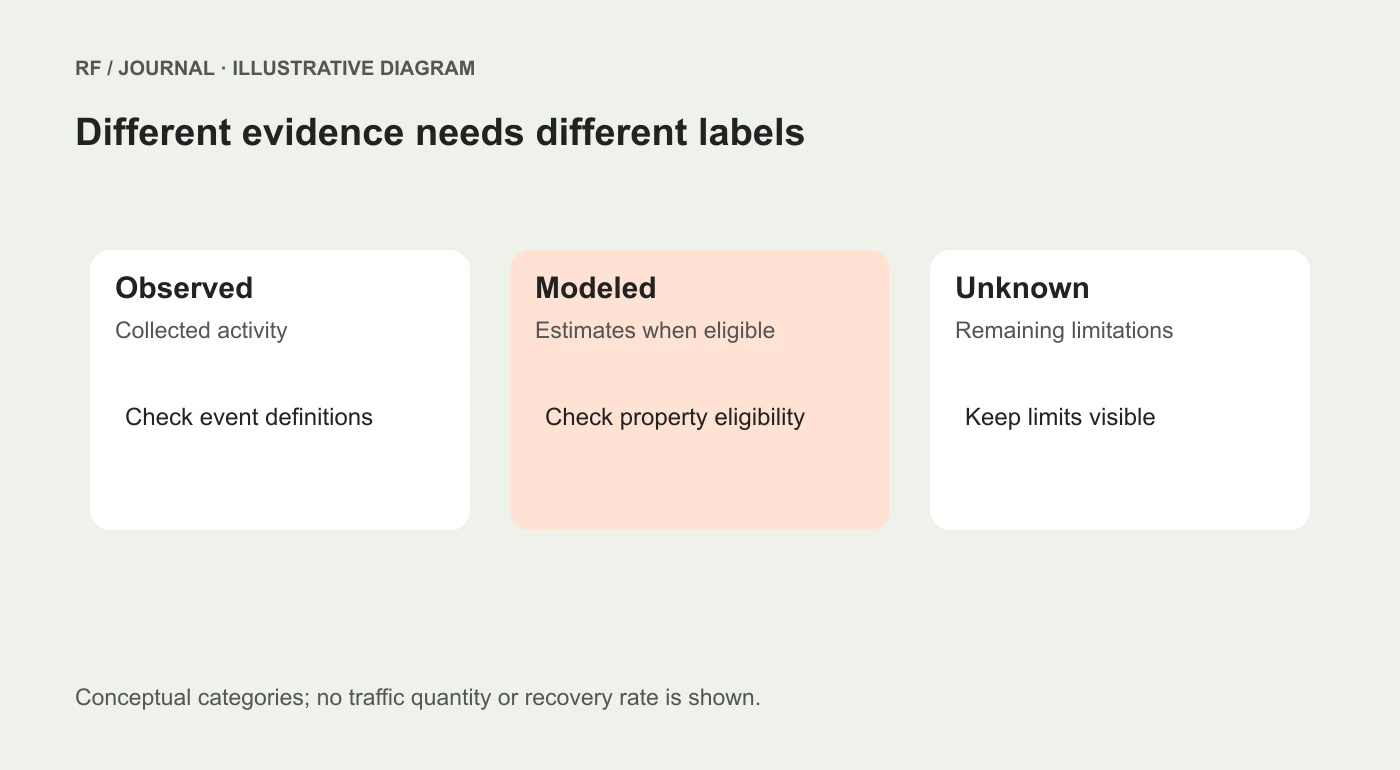
Conceptual reporting categories, not a measured GA4 dashboard or an estimate of this website's missing traffic.
The practical reporting note can be short: “This report may exclude some activity or include estimates under the property's reporting configuration. It is not an exact count of all visitors.” Add the actual configuration details to the internal measurement document.
Build a consent test matrix
Start with a clean test session and synthetic activity. Do not use real customer records to prove that a tag responds to a choice.
| Test state | What to inspect | What the result does not establish |
|---|---|---|
| No choice made | Default state and tag behavior | Whether the banner wording is suitable |
| Relevant consent denied | Behavior matches the selected implementation | That no network request of any kind exists |
| Relevant consent granted | Intended events and storage behavior | That every event parameter is useful |
| Choice changed | Updated state and subsequent behavior | That earlier transmissions are undone |
| Return visit | Saved choice and loading sequence | That every browser retains storage identically |
Use the appropriate tag diagnostics and browser tools to observe the sequence. Record the configuration version, test conditions and result. If a tag fires before its intended default state is available, the order of execution needs investigation.
Include third-party tags in the inventory. A correctly configured Google tag does not explain what a separate advertising, chat or embedded-media script does. Review each integration against the agreed requirements.
For a real project, attach screenshots or logs with sensitive values removed. This article provides the proposed matrix; it does not claim those checks have already passed on your website.
Diagnose a reporting drop without guessing
Suppose reported sessions fall after a consent banner change. Several explanations are possible: collection changed, visitor choices changed, traffic changed, events broke, or the comparison uses different periods or reporting settings.
Write a timeline before changing more settings. Note the banner release, tag release, campaign changes and any relevant outages. Compare equivalent periods where possible, while recognizing that weekday patterns and seasonal activity can differ.
Next, verify that the intended events still work under the appropriate consent state. If the event implementation is broken, debating modeled reporting will not repair it. Then inspect the property's reporting configuration and available diagnostics.
Do not force Analytics to match a server log by adjusting a multiplier. Server requests can include bots, repeated assets and other activity that is not equivalent to a measured session. Two systems can be useful while counting different things.
Keep business records as a separate reference
Orders, saved enquiries and paid invoices can help answer whether the business is receiving activity. They do not automatically reveal the marketing source of each customer.
For example, a saved enquiry record confirms that a form submission was stored. It does not prove that Google organic search caused it, that the person is a qualified lead or that a notification email arrived. Name each metric after the event it actually establishes.
Reconcile aggregate counts only where the definitions allow it. Keep test events separate, document date boundaries and avoid joining personal records to analytics identifiers without an appropriate basis and review.
Our GA4 experiment measurement guide explores why measurement definitions matter before comparing outcomes. The same discipline applies here: establish what the number means before judging whether it improved.
Write a reporting note a business owner can use
A useful handover explains four things: the chosen implementation, the checks performed, the gaps that remain and the decisions the data can support.
An example structure is: “The configured consent states were checked in the documented scenarios on the recorded date. Analytics reporting covers the available observed activity and any estimates supported by this property's settings. It should be read alongside operational records. Changes to the banner or tags require another focused check.”
Replace that wording with the actual verified result. Do not use it as a certification template that gets filled in regardless of the evidence.
If behavioral modeling is unavailable, say so plainly. A small site does not need an imaginary complete dataset to make useful decisions. It can improve event quality, review real customer questions and use appropriately scoped experiments.
Decide what to fix next
Prioritize a mismatch between visitor choice and tag behavior before optimizing dashboard appearance. Next, correct broken or ambiguous event definitions. Then evaluate reporting eligibility and limitations.
If the project involves a new experiment, use our trustworthy A/B testing plan before interpreting differences as a result. Consent-related measurement gaps can affect what the experiment can establish.
Consent Mode is useful when it is part of an understood measurement system. Its value comes from correctly communicating choices and honestly interpreting the resulting data, not from making a chart look comfortably complete.
AI-assisted editorial guidance. Original illustrations are conceptual, not client evidence. Platform documentation checked 22 October 2026.