An AI project can start with a hardware question and end with a software invoice nobody put in the proposal. The GPU is visible, expensive and easy to discuss. Runtime software, model terms, support and the people keeping everything working are less photogenic.
NVIDIA software licensing is receiving fresh attention. In the US Google Trends Technology list checked on 26 October 2026, the query “nvidia ai software gpu licensing fee” appeared as an active trend. That is a reason to investigate the buying decision, not evidence that every NVIDIA GPU now requires a new subscription.
The useful answer for a client is specific: identify the software being deployed, its license, the infrastructure it will run on and the support arrangement. Then cost the intended configuration. A headline about the future of enterprise AI is not a purchase order for the machine under your desk.
This guide uses current official NVIDIA documentation and proposes a practical budgeting process. It does not report a RichFolds GPU deployment, supplier quotation or legal review. Product details were checked on 26 October 2026.
What is new, and what is already documented?
NVIDIA's GTC Berlin keynote coverage, dated 21 October, presents the company's AI infrastructure as a full stack spanning hardware and software. That commercial direction helps explain why software costs deserve attention alongside equipment.
However, the official material reviewed for this article does not establish a newly imposed universal fee on all NVIDIA graphics cards. Do not convert an attention-grabbing price discussion into that claim.
For an actual project, use the product's current documentation and a written supplier proposal. A speech, a future business ambition and a currently orderable entitlement can describe different things. Put the evidence beside the claim before combining them in a client presentation.
Separate the five things a project may need
Use five rows in the initial brief: compute, runtime software, model, application and operations. This is our proposed planning structure, not NVIDIA's contractual classification.
Compute describes where the work runs. Runtime software describes the serving and supporting components. The model describes the weights or service providing the inference. The application turns that capability into a useful task. Operations covers monitoring, maintenance, incident handling and responsibility.
One supplier may package several rows together. Another may charge separately. The important step is to identify what the proposal includes before comparing its total with a different configuration.
For example, a fictional product-catalog assistant might use a hosted model service, a retrieval system and a storefront integration. Another design might run inference on dedicated infrastructure. They could produce similar demonstrations while assigning very different maintenance duties to the client.
What the official pricing page actually says
The NVIDIA Enterprise Licensing Guide lists a one-year self-managed AI Enterprise subscription at $4,500 per GPU, including the stated standard support. Its cloud-hosted section separately lists a production consumption option at $1 per GPU-hour plus the cloud instance costs, alongside development and private-offer arrangements.
Those are different purchasing contexts. They should not be treated as interchangeable quotations or as the complete cost of an AI application. Verify the specific offering, eligibility, included components and current commercial terms before procurement.
A price without a unit is not much of a budget. Write whether the charge applies per device, per hour, per year, per request or under a negotiated commitment. Also record when the charge begins and how usage is counted.
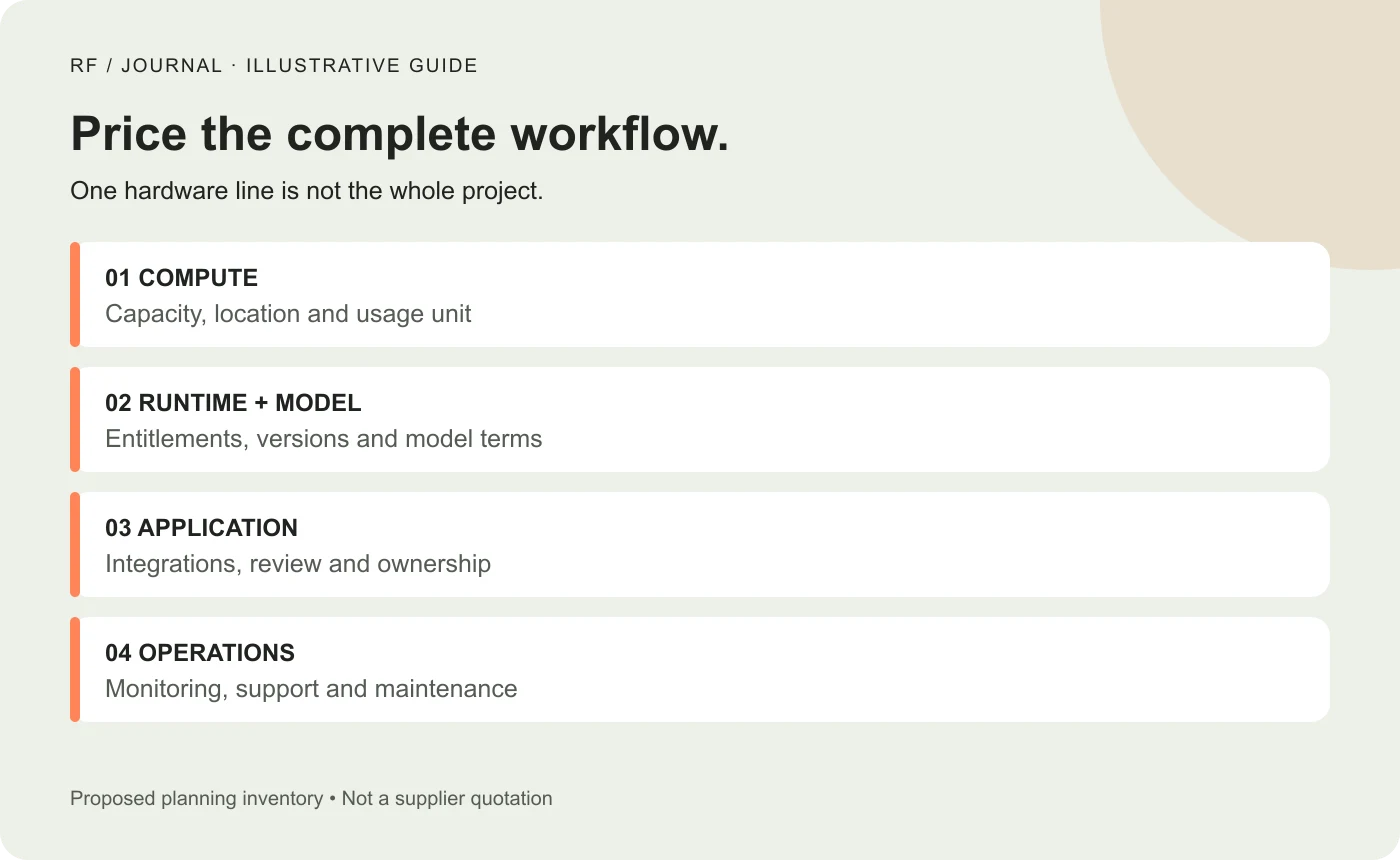
A proposed cost inventory. It is not a supplier quotation or a measured client bill.
A runtime license is not automatically a model license
NVIDIA's licensing overview and FAQ distinguishes NIM runtime licensing from the underlying model's terms. It directs users to model listings and model cards to check those terms. It also explains that many NVIDIA software products are available without a paid subscription, including under open-source licenses.
This is why “we bought the enterprise package” and “we can use any model however we like” are different statements.
Make the model's identity part of the implementation record. Save its exact name, version, source and applicable license reference. If the prototype uses one model and production uses another, reopen the review instead of treating the change as a cosmetic setting.
For a commercial product, ask the appropriate supplier or qualified adviser to resolve uncertainty about permitted use and redistribution. This article provides an implementation checklist, not a legal interpretation of an agreement.
Start with the workload, not the most impressive machine
Describe what the application must do when it is useful. How many requests arrive, how long are the inputs, what response time is acceptable and which tasks can wait in a queue?
For a fictional retailer, the requirement might be to prepare product-copy suggestions overnight and let an editor review them the next morning. That is a different workload from answering a customer at checkout. A specification that says only “fast AI” hides this distinction.
Write an acceptance example using representative, permitted data. Include an ordinary case, a long input and a request the application should decline or escalate. Agree how a reviewer will judge the output before comparing infrastructure options.
Do not use a small demonstration to promise performance at an unmeasured production load. The demo can establish that a workflow is plausible. Capacity planning needs its own evidence.
Build a cost sheet that keeps assumptions visible
Create a row for each charge or recurring responsibility. Suggested columns are item, unit, estimated quantity, source of estimate, owner and confidence level. Leave an unknown visible until someone can answer it.
For compute, distinguish reserved capacity from actual processing time. For software, identify what must be licensed and for how long. For the application, include the work needed to maintain integrations, keep the knowledge source current and review failures.
Then add operating scenarios. A quiet week, a promotion and a retry-heavy incident may place different demands on the system. These are planning cases, not forecasts that the event will occur.
Make double counting easy to spot. If a managed service already includes a particular runtime entitlement, confirm that before adding a second standalone charge. Conversely, do not assume a support line includes all application development.
Compare hosted APIs and self-managed inference fairly
A hosted API and a self-managed deployment are alternative designs that need a comparable brief. The objective is not to prove that one is always cheaper.
For the hosted option, ask about usage units, request limits, data handling, retention settings and integration responsibilities. For the self-managed option, add capacity, runtime requirements, model updates, monitoring and the team's ability to maintain the environment.
Use the same representative task for both. Record which parts of the workflow are included in the comparison and which are simulated. A system that generates a draft and one that also validates, stores and routes it have not completed the same amount of work.
The decision should consider reliability and ownership as well as price. A lower estimated infrastructure bill is less useful if nobody has agreed who responds when the assistant stops returning valid output.
Ask what support covers before an incident
Define a proposed support boundary in ordinary language. Which organization handles the platform? Who investigates application errors? Who maintains the connection to the client's catalog or CMS?
Ask the supplier to confirm service coverage, response commitments and escalation routes in the actual agreement. Do not turn the word “support” into a promise that every integration bug will be fixed by the software vendor.
For an agency, the statement of work should identify the handoff point. A runtime problem, a stale knowledge document and a badly mapped product field may all produce an unsatisfactory answer, but they need different fixes.
Our AI customer-support knowledge guide explains the content side of that responsibility. Paying for more capable infrastructure does not make an outdated returns policy accurate.
A practical pilot for a small business
Keep the first exercise narrow. For a proposed catalog-copy workflow, use a small synthetic set of product records and require the assistant to return a draft with the source fields it used. Do not give it authority to publish the catalog changes.
Record the configuration and the limits of the exercise. Capture representative completion times, failures and review effort only if the test is actually run. Until then, label those fields as planned measurements.
At the end, answer three questions: did the output meet the brief, can the team operate the workflow, and is the estimated production cost supported by the observed workload and confirmed commercial terms?
If the task is useful but the operating model is too demanding, consider a simpler design. If the task itself is not valuable, changing the GPU or license will not rescue the business case.
What to put in a client proposal
Separate confirmed items from estimates. Name the vendor documentation checked, date the price reference and state that procurement depends on the supplier's current quote and applicable terms.
List the intended model and software components rather than calling everything “the AI.” Explain who owns the application, who can approve model changes and which recurring duties are covered by the agency.
For broader website planning, our CMS selection guide follows the same principle: begin with the team's work and the decisions it must maintain. The platform is part of that plan, not a replacement for it.
The useful next step
Before approving an AI infrastructure budget, request one diagram of the intended system and one cost sheet with units, owners and unresolved assumptions. Ask the supplier to confirm the license scope against that design.
That is more useful than arguing about whether a headline sounds expensive. A clear project can be compared, priced and maintained. A collection of impressive nouns usually needs another meeting.
AI-assisted editorial analysis. Original images are conceptual, not actual infrastructure, vendor interfaces or client results. No NVIDIA partnership, procurement advice or completed deployment is claimed.