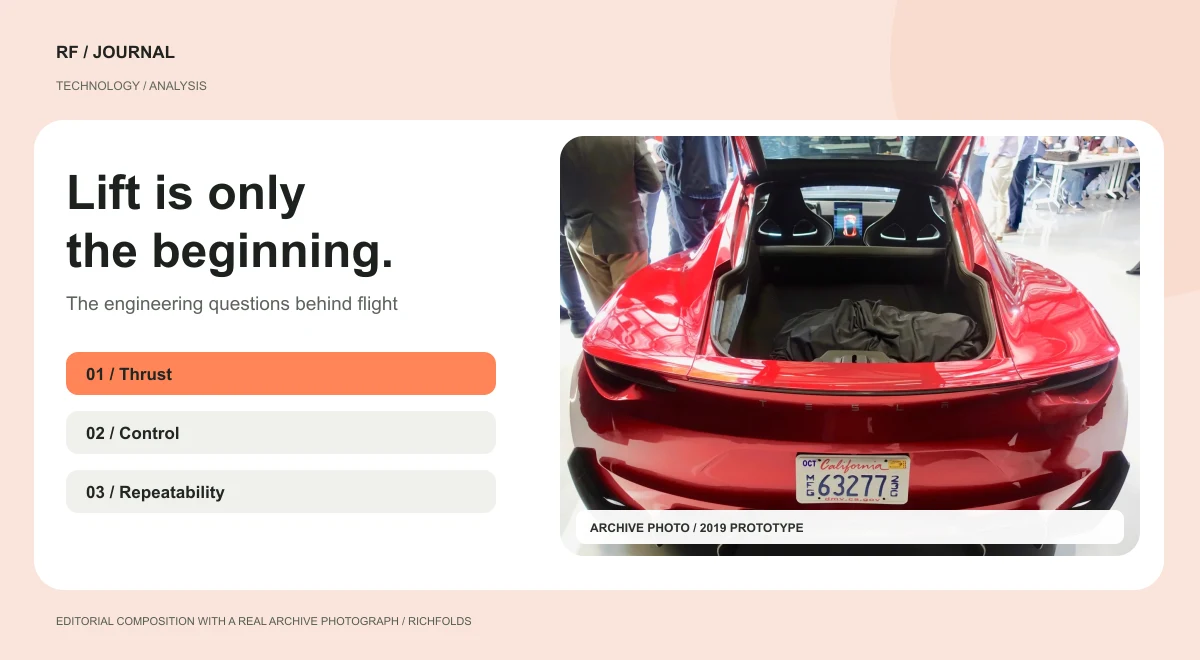
Cover photograph: Steve Jurvetson, CC BY 2.0. Cropped and arranged in the RichFolds editorial cover.
A brief lift, a controlled rotation and a useful flight between two places are different engineering tasks. The discussion around Elon Musk’s Roadster becomes much more interesting when we stop treating them as the same achievement.
The October 2026 reveal has prompted renewed interest in a sports car using thrusters. Here, we explain the underlying forces and the questions a complete system would have to answer. We are not reconstructing Tesla’s proprietary design, certifying its safety or claiming to have tested the vehicle.
The central idea is simple: a machine can change its motion by accelerating matter in another direction. Making that force useful, controllable and repeatable is the difficult part.
Engineering explainer checked on 16 October 2026. All photographs are dated archive images. None shows a verified diagram of the new Roadster’s internal hardware.
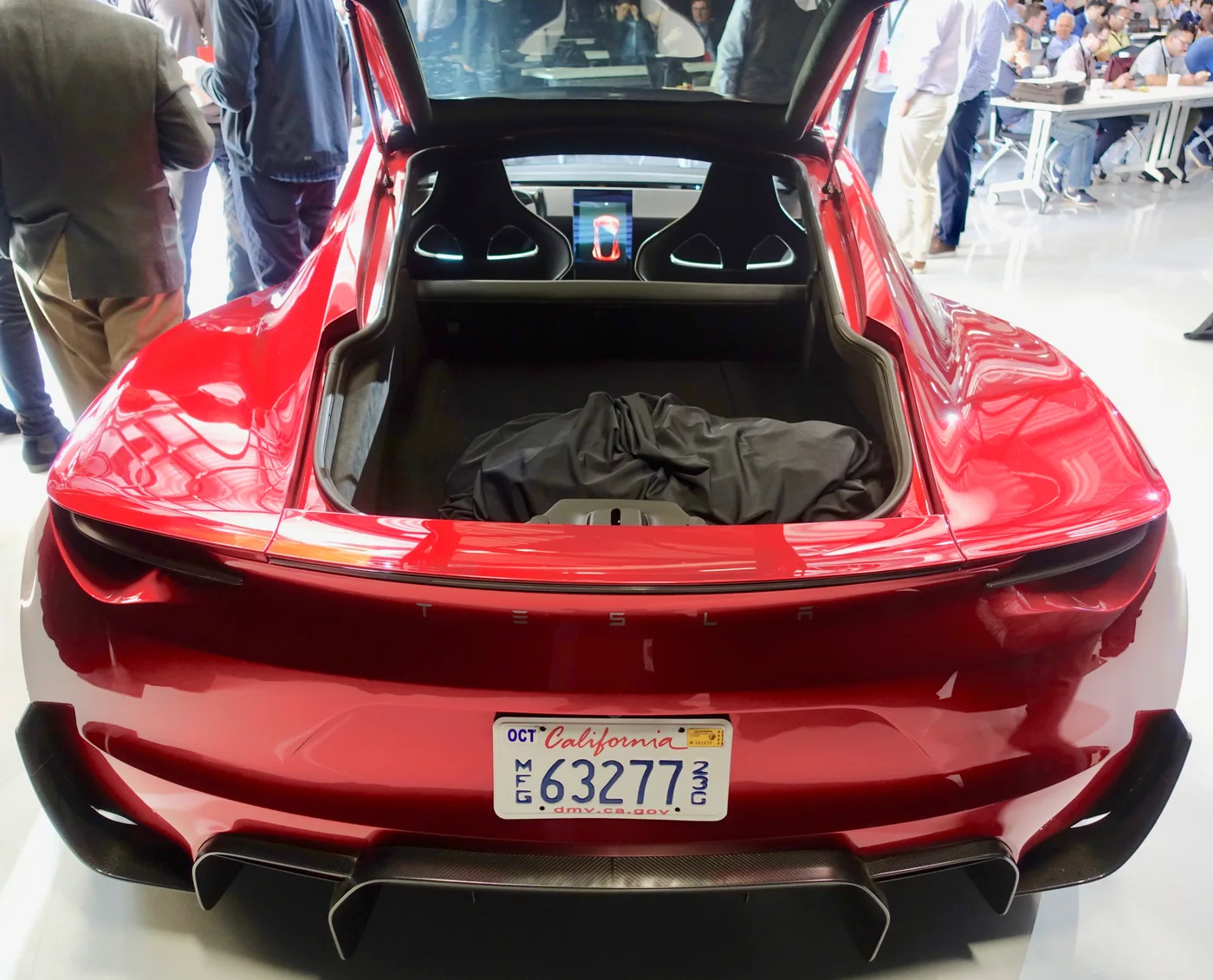
A thruster is a force-producing device
A propulsion system produces thrust by accelerating a working fluid. The reaction pushes the system in the opposite direction. A nozzle can give that flow a direction, which helps determine where the force acts.
Burning fuel is one way to create the conditions for that flow. A cold-gas system instead releases stored pressurized gas without burning it in the thruster. Describing both systems as “rockets” can conceal important differences in how they store energy and produce exhaust.
That distinction is useful when reading coverage. A claim about compressed gas does not establish that a sports car carries the same engines as a launch rocket. Nor does the involvement of a space company mean every component has been transplanted directly from a spacecraft.
This is an explanation of general propulsion principles. The gas, pressures, layout, control logic and usable duration of a specific vehicle need their own documentation. We are not guessing those details from photographs.
Leaving the ground is only one part of the task
For a simplified stationary hover, upward support must balance the vehicle’s weight. To accelerate upward, the net upward force must be greater. That basic force balance explains why “it has thrusters” is an incomplete answer to “can it fly?”
The forces must also act in the right places. A force applied away from the center of mass can turn the vehicle as well as move it. A system must manage orientation, not merely produce a large upward push.
As an illustration, imagine supporting a tray from underneath. Supporting its middle is different from pushing up at one edge. A real vehicle is much more complex, but the example shows why placement and control are inseparable from raw thrust.
Once a vehicle is airborne, steering tires no longer provide the same ground-contact mechanism. The machine needs a way to control its motion through the airborne portion and return to the ground in a managed condition.
Control deserves as much attention as lift
A useful explanation of an airborne vehicle should distinguish three questions:
- Can the system produce the required force?
- Can it direct that force to maintain the desired motion and orientation?
- Can it respond appropriately when actual conditions differ from the plan?
A demonstration can offer evidence for a particular sequence. It does not, by itself, describe every condition the system can handle. Readers should look for the operating envelope: the circumstances within which the behavior has been designed and tested.
We would want published information about preparation, supervision and limits before discussing everyday operation. A video alone does not answer whether the maneuver is manually commanded, automated, remotely controlled or performed using a particular combination of those methods.
Those distinctions are especially important when a short clip removes the beginning or end of an event. A dramatic middle frame says little about the setup and recovery process.
Stored gas creates a duration question
A stored-gas system has a finite supply available for a maneuver. Increasing the time it must produce a particular force changes the amount of working fluid required. Tanks, valves, plumbing and the fluid itself also form part of the complete system.
This creates a practical distinction between a brief maneuver and a sustained journey. A short burst may be sufficient for a particular demonstration. Longer operation brings different storage, mass and replenishment questions.
We cannot calculate the Roadster’s usable airborne time without verified design data. A calculation based on an invented vehicle mass or assumed tank capacity would create an impression of precision without establishing anything about the actual car.
The more useful public information would describe a repeatable operating cycle: preparation, maneuver, recovery, inspection and return to readiness. That cycle tells an owner more than an isolated claim about peak performance.
Fans and thrusters should not be treated as synonyms
A fan accelerates surrounding air. A stored-gas thruster releases a working fluid carried by the system. They can both produce forces, but their operating context and resource limits differ.
The direction of a force matters too. A system that helps hold a vehicle against a surface is performing a different task from one that supports it in free flight. Describing both as “more grip” or “more lift” without identifying the setting can confuse the mechanism.
For this reason, the sensible question about a complex demonstration is not simply which device appears in it. It is what each device contributes during each phase of the sequence. Launch reporting alone does not provide enough detail for us to assign every observed motion to a particular component.
A rocket payload is not a self-flying car
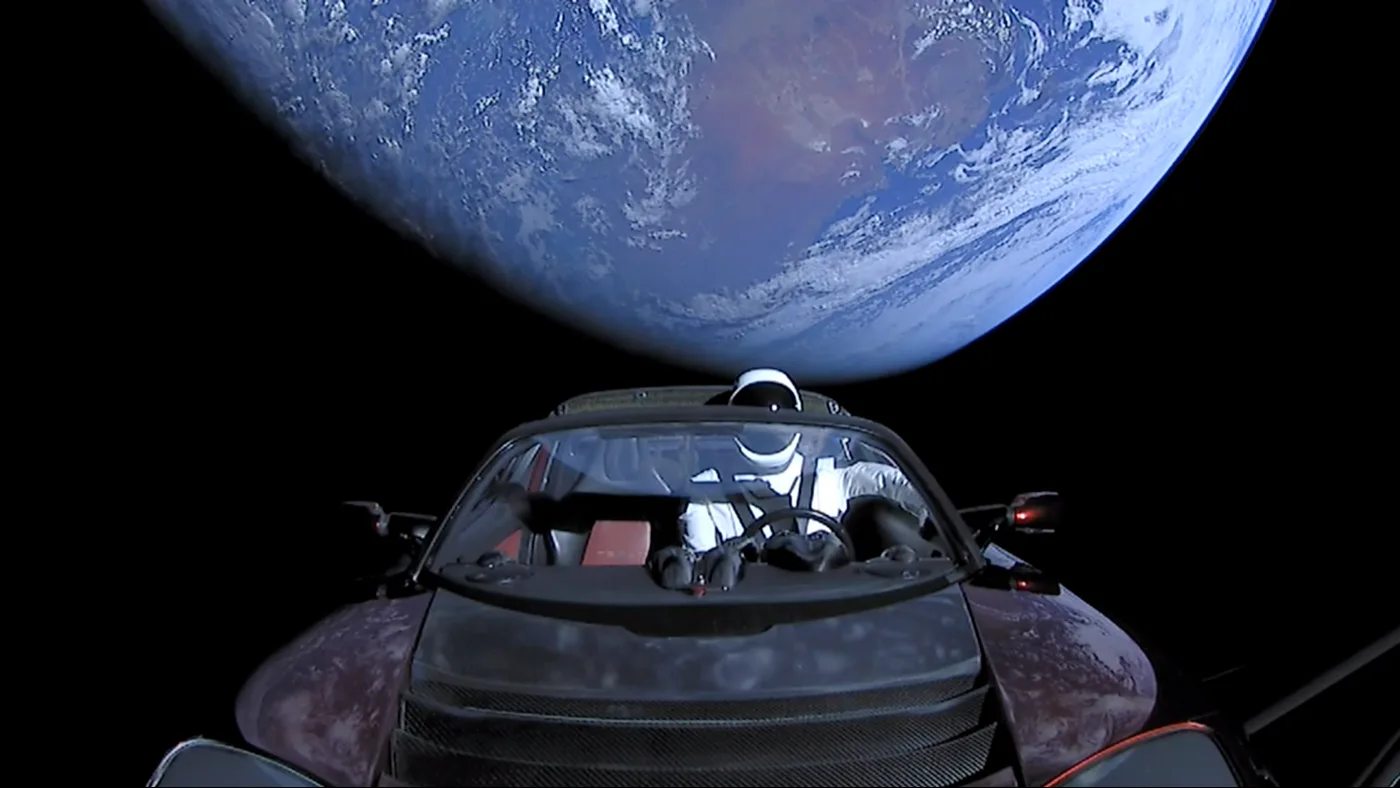
The famous photograph of a Roadster with Earth behind it records the 2018 Falcon Heavy demonstration mission. The car was carried as a payload. Its appearance in space is not evidence that the road vehicle had a flight propulsion system.
That image remains relevant to the cultural link between the two companies. It is a poor illustration if presented without a date under a headline about a newly airborne sports car. A real photograph can still create a false impression when its caption or placement removes the context.
Here, it is included to explain that distinction, not to illustrate the October 2026 vehicle flying.
What technical evidence would be persuasive next?
For readers who want to move beyond spectacle, the useful next documents would identify the exact configuration, supported maneuvers, operating conditions, preparation requirements and limits. A clear explanation of how faults are handled would matter as well.
Repeated tests would be more informative than a single successful sequence. The conditions and configuration would need to be recorded so the results could be interpreted rather than simply admired.
The wider aviation context also matters. Aircraft operations involve questions about the vehicle, its operator, the person controlling it and the environment in which it flies. A dramatic car demonstration does not settle those questions, and we are not assigning the Roadster an aviation classification in this article.
Our assessment is that the interesting challenge is system integration. Producing force, controlling motion, managing stored resources and defining a usable operating envelope must work together. That is a much more demanding problem than adding a visually impressive component to a sports car.
Understanding those distinctions makes the demonstration more interesting, not less. It gives us better questions to ask when the next specification or test result appears.